
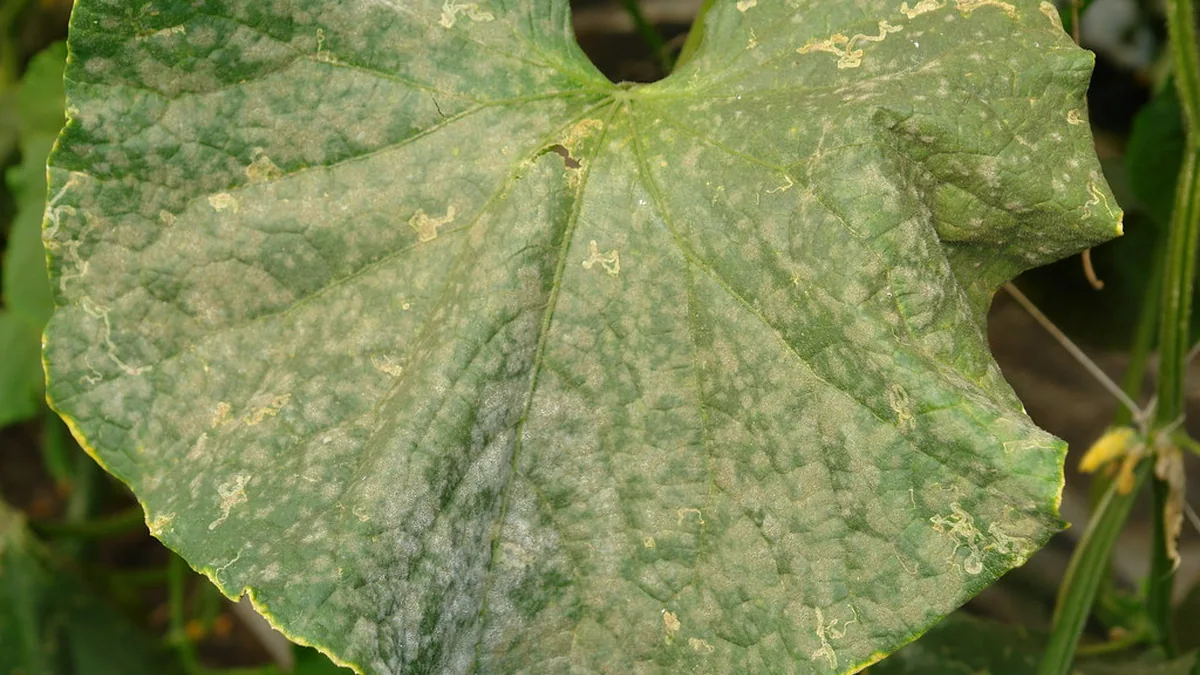
Your cucumbers looked healthy a fortnight ago. Now some leaves have pale, dusty-looking patches. They spread, join up and gradually make the whole plant look as though someone has shaken flour over it.
That sounds like powdery mildew, one of the most common fungal problems on garden and greenhouse plants.
The name is helpful because the symptoms are distinctive, but it can also lead you in the wrong direction. Unlike many fungal diseases, powdery mildew doesn't need wet leaves to establish. A greenhouse can develop a mildew problem even when you're being careful not to splash water over the foliage.
The good news is that a light infection doesn't always mean you'll lose the crop. The useful response is to identify the disease, remove badly affected growth where appropriate and adjust the growing conditions.
What does powdery mildew look like?
The classic sign is a white or pale grey, powdery coating on the leaf surface. It may begin as a few small patches and spread until much of the leaf is covered.
Powdery mildew is caused by a group of related fungi that grow across the surface of leaves, shoots and sometimes flowers or fruit.
On cucumber plants, the coating often appears on the upper leaves first. Infected foliage may later turn yellow, dry out or die prematurely.
Some other plants develop distorted shoots or discoloured patches rather than an obvious thick coating, so the appearance varies by host.
A healthy cucumber leaf normally feels slightly textured, but it shouldn't have spreading white fungal growth across it.
If you aren't sure, check several leaves and compare the symptoms with reliable photographs of the specific plant.
Is it powdery mildew or grey mould?
They're different problems and may need different attention.
Powdery mildew usually produces pale, powdery patches over the surface of living foliage.
Grey mould, often caused by Botrytis cinerea, tends to produce fuzzy grey growth on decaying or damaged tissue, especially flowers, stems and fruit in humid conditions.
Condensation on greenhouse glass doesn't prove that powdery mildew is present, and a white patch isn't always a fungal disease. Residue from sprays, dust, sun scorch or other leaf damage can sometimes look similar at first glance.
Look for spreading colonies on multiple leaves and whether the plant's health is changing. Compare symptoms across several leaves rather than assuming every pale patch is mildew.
Correct identification saves you from treating the wrong thing.
Why does powdery mildew appear in a greenhouse?
Several conditions can make infection more likely.
Crowded plants restrict airflow. Leaves remain surrounded by humid air, and a dense canopy can create a favourable environment for fungal spores.
Plants suffering from dry roots or irregular watering may also become more susceptible. This catches people out because they assume every fungal problem must come from watering too often.
Powdery mildew can develop where the air is humid but the plant's roots are comparatively dry. The fungi don't generally need a film of free water on leaves to infect them.
High temperatures, uneven moisture, susceptible varieties and poor spacing can combine to create a difficult environment.
A greenhouse with closed vents and several large cucumber plants pressed together is particularly vulnerable during warm periods.
Are cucumbers especially susceptible?
Cucumbers, courgettes, marrows and other cucurbits are frequent hosts. Their broad leaves provide plenty of surface area for infection.
Cucurbits are among the groups commonly affected by powdery mildew.
You may also encounter the disease on grapevines, peas, ornamental plants and other crops kept under glass.
But powdery mildew isn't one single fungus that infects every plant in exactly the same way. Different species of the fungus tend to have narrow host ranges.
That means mildew appearing on a cucumber doesn't automatically mean every nearby rose or grapevine will catch the same infection.
However, the conditions encouraging mildew may also be stressful for other plants, so checking spacing and watering across the greenhouse is still worthwhile.
What should you do when you first notice it?
Start by assessing how widespread it is.
If only a few older leaves have light patches, you may still have plenty of healthy growth. Check whether the plant is receiving enough water at the roots and whether air can move between plants.
Remove badly affected or dying leaves where appropriate, taking care not to strip away all the healthy leaf area that feeds developing fruit.
Put infected foliage into suitable waste disposal rather than leaving it lying on greenhouse benches or paths.
Clean secateurs after cutting diseased material, particularly before using them on other plants.
Avoid brushing or shaking affected leaves unnecessarily, which can release spores.
If the plant is already near the end of its cropping season, removing it after harvest and cleaning the growing area may be more useful than trying to nurse it along indefinitely.
Does increasing ventilation help?
It can improve the greenhouse environment, although it isn't a guaranteed cure once the fungus is established.
Ventilation reduces pockets of still, humid air and helps prevent the very dense, stagnant conditions in which diseases often become troublesome.
Open vents appropriately during warm weather and avoid letting foliage press against greenhouse glazing or neighbouring plants.
For cucumbers, be sensible. They like warmth and shouldn't be exposed to an icy draught merely because you're trying to move more air.
Give plants enough space and maintain an open growing environment as part of powdery mildew management.
For the separate issue of moisture control during colder months, read greenhouse ventilation in winter.
How should you water a plant with mildew?
Keep the root zone evenly moist according to the crop's needs, without turning it into a bog.
A cucumber with dry roots may become stressed, which won't help its ability to cope with disease. Water the growing medium adequately and regularly, especially while fruits are forming.
Don't assume spraying leaves repeatedly is the answer. While powdery mildew dislikes direct contact with water, consistently wetting foliage can encourage other diseases, particularly if leaves stay damp overnight.
Avoid prolonged leaf wetness and balance irrigation with good airflow.
A mulch around the roots can help maintain moisture in suitable beds, provided it doesn't smother the stems.
If plants are in grow bags or small pots, check them particularly carefully during hot weather. They can dry out quickly even when the greenhouse air feels humid.
Should you remove all the infected leaves?
No. Not automatically.
A few infected leaves can often be removed without much effect on the plant. But a cucumber needs its healthy leaves to produce energy for fruit development.
Stripping nearly every leaf may reduce the harvest more than a moderate mildew infection would.
Remove leaves that are clearly badly affected, yellowing or dying, while preserving sound growth.
If the infection is widespread and the crop is nearly finished, it may be more practical to clear the plant and prepare the space for the next crop.
The right response depends on the severity of the problem, the time of year and how much useful crop remains.
What about fungicides or home remedies?
You'll find plenty of suggestions for milk sprays, baking soda mixtures, oils and commercial products.
Their effectiveness can vary, and some preparations may damage foliage, particularly in the warmth and bright light of a greenhouse.
Manage powdery mildew through good cultivation, hygiene, suitable varieties and growing conditions rather than routinely relying on fungicides.
Don't spray bleach, household cleaners or strong homemade chemical mixtures onto edible plants.
If you do consider a commercial plant-protection product, check its current UK authorisation for the crop and disease and follow the label precisely, including any harvest restrictions.
Good growing conditions are the foundation of prevention, whether or not a product is used.
Can you stop powdery mildew returning next year?
You can reduce the risk, although you can't guarantee that fungal spores will never reach the garden again.
Choose varieties described as having useful resistance where available. Space plants so air can move between their leaves rather than squeezing an extra cucumber into every gap.
Water consistently and inspect foliage regularly through the growing season. Prompt attention to the first small patches is easier than responding when the whole canopy is affected.
At the end of the crop, remove old, diseased plant material and clean the growing area. Emptying the greenhouse of exhausted plants can also make it easier to inspect vents, glazing and staging.
Avoid saving visibly diseased propagation material for the next season.
If the same variety suffers every summer despite good care, trying a more resistant cultivar may make a bigger difference than buying another spray.
Is powdery mildew worse in summer or winter?
On typical greenhouse cucumbers, powdery mildew is primarily a growing-season problem. It tends to appear from spring onwards, when leafy growth provides plenty of susceptible tissue.
Winter is a good time to clear old crop debris and improve the layout for next year. Don't confuse ordinary condensation or grey mould in a cool winter greenhouse with powdery mildew.
When should you give up on an infected crop?
If a lightly infected plant is still producing healthy fruit, keep looking after it. If most foliage has died and the season is almost finished, clearing the plant may be the sensible choice.
Remove diseased debris and clean tools. The aim isn't to save every leaf; it's to maintain a worthwhile crop without letting infected material accumulate.
See also our winter greenhouse crop guide and greenhouse ventilation advice.