
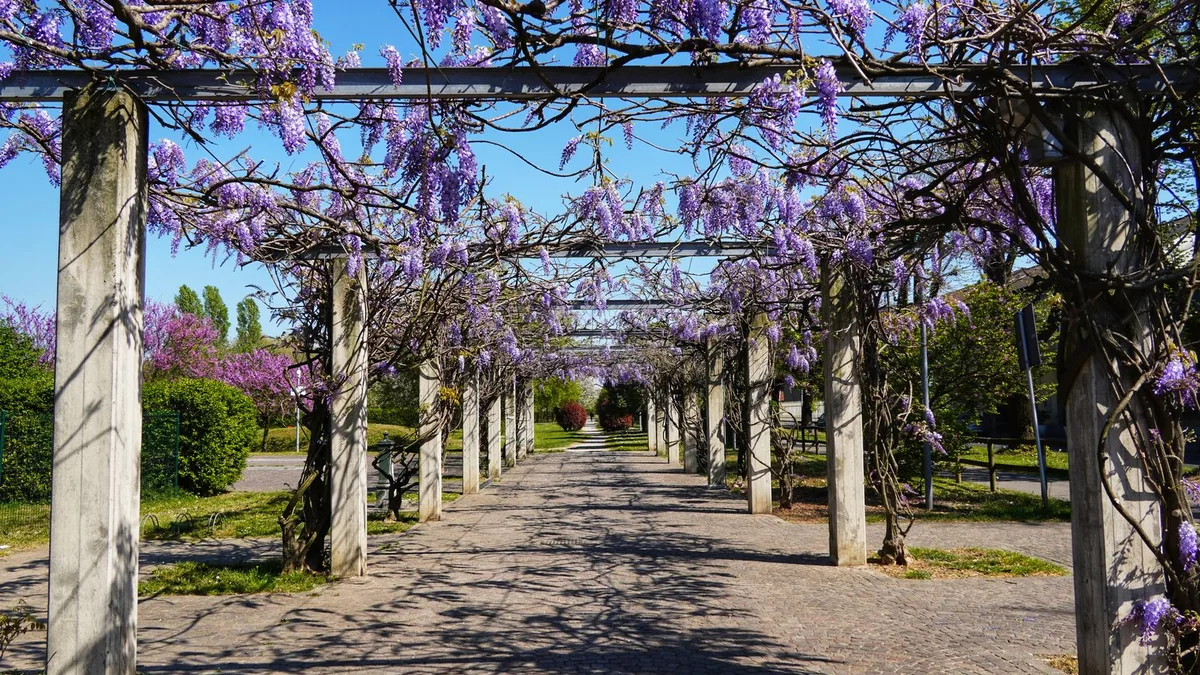
Wisteria can be spectacular in flower and completely unruly by the end of summer. Those long green shoots that seem to grow overnight are normal, but if you let them take over every year, the plant can smother its support and hide much of its flowering wood.
Fortunately, pruning wisteria doesn't need to be complicated. For an established plant in the UK, the reliable approach is two prunes a year: one in July or August and another in January or February.
The summer cut controls the long whippy growth. The winter cut shortens those same shoots further, helping to create a framework of compact flowering spurs.
Why does wisteria need pruning twice?
Wisteria grows vigorously in the right conditions. During summer it sends out long, leafy shoots that may twine around gutters, railings or neighbouring plants.
Those shoots are useful while you're building a framework, but once the plant has filled its support, you don't need them all to keep extending indefinitely.
The summer prune allows more light and air around the developing wood, encouraging the plant to form flower buds. The winter prune concentrates the remaining growth into short spurs that are easier to maintain.
This routine suits established wisterias grown on walls, arches and pergolas. A very young plant that's still covering its support needs a gentler approach.
When to prune wisteria in summer
July or August is the usual window, after the main spring flowering has finished and long shoots are easy to recognise.
Pick a dry day and look for the soft, green, whippy stems that have grown during the current season. These can reach surprising lengths, sometimes winding through nearby shrubs or across windows.
For a mature plant with an established framework, cut these unwanted new shoots back to around five or six leaves from their point of origin.
You don't need to cut every green shoot. If you're training a replacement framework branch into an empty part of the wall, keep it and tie it in instead. The aim is to shorten growth you don't need, not remove the plant's future structure.
Dispose of cut material before it tangles itself around other plants. Wear gloves, as long shoots can be awkward to handle and may whip back when released.
When to prune wisteria in winter
The second cut is made in January or February, when wisteria is dormant and the leaves have fallen.
Now you can see the framework clearly. Find the shoots you shortened in summer and cut them back again, leaving two or three buds. On many stems, this means a short spur a few centimetres long rather than a long branch.
Make a clean cut just above a suitable bud with sharp secateurs. Avoid tearing the bark or cutting right into the main branch.
You may also find new long shoots that grew after the summer prune. Shorten those appropriately while keeping useful framework growth.
This winter stage is not an excuse to shorten all the thick old branches. They support the flowering spurs. Remove them only for a clear structural reason.
The easiest way to remember the pruning rule
| Season | What you cut | How far |
|---|---|---|
| July–August | Long new green side shoots | Shorten to 5–6 leaves |
| January–February | Those shortened shoots, now dormant | Shorten to 2–3 buds |
That simple routine is the foundation of regular wisteria pruning.
If you're reading this in November and wondering whether to get out the secateurs immediately, routine winter pruning can usually wait until January or February. Only deal with urgent damage or a branch that is putting a structure at risk.
How to tell a framework stem from a side shoot
A mature wisteria may have thick, twisting main stems that have been trained along wires or over a pergola for years. Those are its framework.
Thinner shoots grow out of that framework and produce leaves and flowering spurs. They're the growth you normally shorten each summer and winter.
Before cutting, follow the stem back to where it starts. Is it supporting a large section of the plant? Is it a useful new shoot heading into a gap? Or is it a long side shoot weaving across the window?
Taking a moment to answer that question can prevent a mistake that takes years to grow back.
On an old plant, some stems are wrapped tightly around each other. Don't start tugging a heavy branch loose until you know where both ends go.
How to train wisteria against a wall
A strong support system makes pruning much easier.
Use horizontal galvanised wires on suitable wall supports, spaced at roughly 30cm intervals, to train wisteria as a fan or espalier-like framework.
Choose a few main stems and guide them across the wires while they're still flexible. Leave some space between plant and wall for airflow and access. Use suitable ties that allow stems to thicken without being constricted.
Wisteria becomes heavy and woody over time. A flimsy trellis that looks fine when the plant is small may be unsafe after several seasons.
Keep main stems away from gutters, drainpipes and weak roof edges. The shoots naturally twine around nearby objects, so check them during summer rather than leaving the job until winter.
Pruning wisteria on a pergola or arch
A wisteria over a pergola can be wonderful because the flowers hang beneath the framework where you can look up into them.
However, the structure must be robust. Mature stems can become heavy, and dense foliage catches wind.
Let the main framework grow across the top, then shorten excessive side growth in summer and again in winter. Try to keep access to the support for routine inspections and pruning.
If stems have grown inside joints, around bolts or beneath roofing materials, the situation may need careful work by someone experienced with mature climbers. Pulling woody stems away can damage the structure.
Don't expect pruning alone to solve a support that was never strong enough for the plant.
Should you prune a young wisteria?
Not in the same way as an established one.
Allow a young wisteria to cover its intended wall or support before beginning the full twice-yearly pruning routine. During that formative period, tie in shoots that are growing in useful directions and remove those that cause obvious problems.
A new plant may not flower immediately. Grafted named varieties usually flower sooner than seed-grown plants, but even a good plant needs time to establish.
If you cut every new shoot back to a few buds while the plant is still trying to cover the wall, you'll slow down the job it needs to do.
How to renovate an overgrown wisteria
If the plant has gone years without pruning, don't try to turn it into a perfect display in one afternoon.
Begin by checking the main framework, the condition of the support and whether branches are damaging windows, gutters or nearby trees. Remove dead or clearly unwanted growth and plan what you want to retain.
Severe renovation can involve removing old stems and cutting selected branches back to strong younger growth, often during dormancy. But hard cuts may stimulate a great deal of vigorous regrowth.
Flowering can take two or three years to return after substantial renovation. That's a good reason to take a measured approach if the plant is healthy but untidy.
When major stems have twisted around important parts of a building, get expert advice rather than risking damage.
Why won't my wisteria flower?
Pruning can help, but it isn't the only factor.
Too much shade: wisteria generally flowers best in full sun. A plant shaded by mature trees may grow plenty of leaves with few flowers.
A young or seed-grown plant: some seedlings take many years to flower. A named grafted plant is usually a better choice if flowers are your priority.
Too much nitrogen: heavy feeding can encourage lush leafy growth rather than a good flower display.
Wrong pruning: leaving all the long shoots, or cutting off useful spurs, can reduce the flowering effect.
Weather: late frosts can damage developing flower buds, even on an otherwise healthy plant.
Think about those conditions before resorting to a drastic prune. A wisteria already in deep shade won't be transformed by cutting every stem back hard.
What if you missed the summer prune?
Don't panic. If it is now January or February, you can still identify and shorten excess growth while the plant is dormant.
You won't recover the whole benefit of summer pruning, but you can tidy the shape and begin a better routine next growing season.
Likewise, missing one winter prune doesn't mean the plant is ruined. Do the next summer cut properly and return to the usual cycle.
Keep it simple
Once your wisteria has filled its support, the annual plan is straightforward: five or six leaves in summer, then two or three buds in winter. Keep new framework growth where needed and don't chop old main stems unless there's a good reason.
That leaves you with a manageable plant and gives its flowers a better chance to be seen.
For other seasonal pruning advice, see what to prune in November and our November garden jobs checklist.