
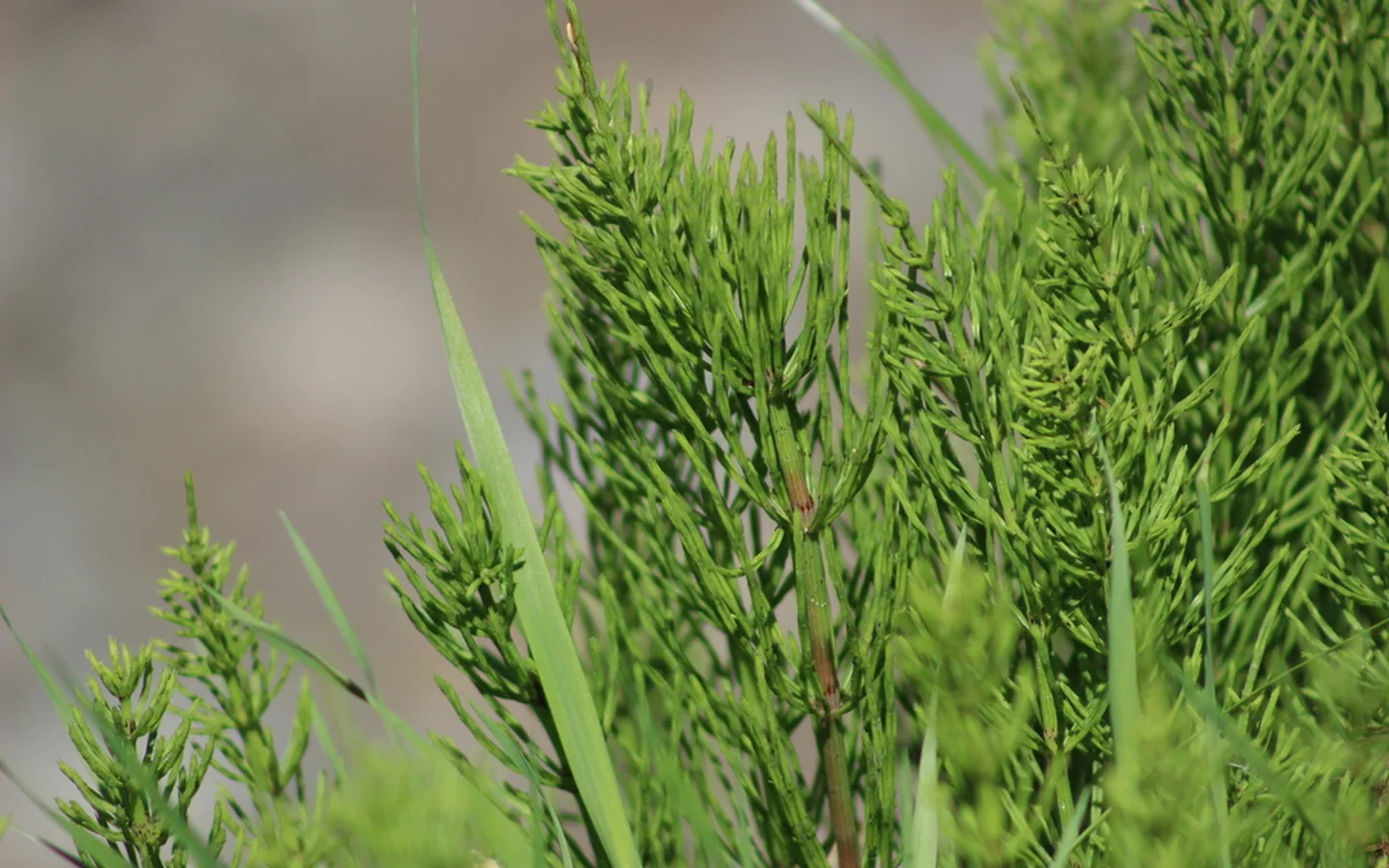
Field horsetail can look almost prehistoric: tall green shoots with rings of fine branches, emerging from underground stems that seem to reach everywhere. It also has a reputation for being impossible to kill.
The reality is more useful. Horsetail is difficult to eradicate quickly, but regular suppression can keep it from overwhelming planting, and small new colonies can sometimes be removed before they spread.
Identify field horsetail before starting
Field horsetail (Equisetum arvense) has two distinct types of stems.
In early to mid-spring, it may produce brownish, unbranched fertile shoots with a cone at the top. These release spores. Later come the familiar upright green stems with whorls of narrow side branches, resembling miniature fir trees.
The plant doesn't produce ordinary leaves and flowers like most garden weeds. It spreads mainly through a network of dark underground rhizomes and tubers that can reach very deep.
Some other Equisetum species grow in wetlands or by ponds. Identify the actual plant before removing it indiscriminately.
Why is horsetail so persistent?
Its underground rhizomes store food and allow new stems to emerge even after all visible growth has been pulled.
Rhizomes can reach up to about two metres deep in favourable soils. That makes digging every part out of an established patch unrealistic.
Viable fragments can regenerate. Rotavating or transferring infested soil can spread the problem, just as with couch grass or ground elder.
Horsetail also reproduces by spores, although spread in a cultivated garden is often more strongly associated with underground growth.
What actually works?
| Method | Useful for | Main limitation |
|---|---|---|
| Regularly pulling green shoots | Borders and between established plants | Needs repeating over several seasons |
| Careful forking out accessible rhizomes | Small new infestations | Deep sections may remain |
| Repeated mowing | Infested lawns | Can take time |
| Prolonged light-excluding covering | Empty sections of garden | Covering may need to remain for years |
| Planting robust shade-producing shrubs | Large existing borders | Not suitable for every planting design |
| Moving clean plants out of an infested site | Preparing a new bed | Soil on roots may carry fragments |
There is no credible one-week cure for an old colony spreading through heavy soil.
How to remove a new, small infestation
- Identify the shoots and check the size of the patch.
- Work when the soil is moist enough to lift without smearing.
- Use a hand fork or border fork to expose accessible dark rhizomes.
- Remove long sections as intact as possible.
- Avoid chopping the underground growth into fragments.
- Keep any removed material and contaminated soil separate from clean compost.
- Mark the area and remove each new green shoot promptly.
When only a few rhizomes have arrived with a plant or soil delivery, early removal may prevent a major infestation.
Repeated cutting: why it eventually helps
Green horsetail stems photosynthesise, allowing the plant to rebuild food reserves underground.
When you keep cutting or pulling those stems, roots must use stored energy to produce replacements.
Remove shoots before they grow large and replenish reserves. A few regular sessions in the growing season are more useful than a dramatic clearance followed by months of neglect.
For an established border, this may mean management rather than total eradication. That's a reasonable result if your other plants can thrive.
Horsetail growing through perennials
Don't pull a valuable perennial apart to chase every dark rhizome passing through its roots.
Remove accessible horsetail shoots and work gently with a hand fork in open spaces. Where a perennial can safely be lifted and divided, inspect the rootball and remove rhizome pieces before replanting.
A dense vigorous shrub may cope with horsetail underneath it without much competition. Small seedlings are more vulnerable to being shaded or crowded.
Focus effort on the plants that genuinely need protection.
How to control horsetail in a lawn
Regular mowing prevents green stems from building up food reserves above ground.
If the lawn is otherwise healthy, maintaining a sensible mowing schedule may gradually weaken the horsetail enough that it is no longer obvious.
Don't scalp the grass or spray a general lawn weedkiller expecting it to kill an unusually resilient horsetail rhizome network.
When the turf is weak, maintain grass health as well; our grass seed guide explains how to strengthen thin areas.
Will cardboard and mulch work?
Covering an empty area with opaque compostable material and a deep layer of organic mulch can suppress shoots and starve roots of light over time.
The RHS describes using cardboard plus around 20cm of organic mulch for horsetail suppression, with the cover maintained and topped up for several years where necessary.
That is a long-term strategy, not the same as applying a normal decorative 5cm bark layer. Strong shoots may find gaps at edges.
For a border already full of wanted plants, repeated pulling is often easier than trying to cover every stem and crown.
Does horsetail mean the soil is waterlogged?
Horsetail often grows in damp or compacted soil, but it can also survive in quite ordinary growing conditions.
It is not a dependable soil-moisture test. Investigate drainage separately before spending money on a new drainage system simply because horsetail is present.
A properly structured garden bed may still have horsetail whose deep roots were established years before.
Should you use weedkiller?
Home-garden weedkillers are often disappointing against horsetail because its foliage is tough and resistant to wetting, while rhizomes survive deep underground.
The RHS recommends non-chemical controls. Even systemic products may require repeated applications over a long period and can harm surrounding plants.
Only use an authorised product for a legal intended purpose, following the current UK label. Avoid concentrated vinegar, bleach or other improvised chemicals.
Disposing of horsetail safely
Don't put fresh rhizomes into a cool home compost heap. They may survive and be spread with finished compost.
Use an appropriate council green-waste collection or recycling site that accepts the material. Clean tools and avoid transporting infested soil to a fresh planting area.
Large amounts of contaminated soil may need special handling; don't simply tip it over the neighbouring boundary.
A realistic management schedule
Spring: identify early fertile stems and remove green shoots as they appear.
Summer: pull or cut new green growth regularly, focusing on seedling beds.
Autumn: tidy dead stems and check where rhizomes are emerging.
Winter: plan any empty-bed covering and improve access for next season's control.
For other rhizomatous weeds, our weed membrane calculator can help estimate covering material, but no membrane quantity guarantees complete suppression.
Common mistakes
- Rotavating a horsetail-infested bed.
- Expecting one spray to reach two-metre-deep rhizomes.
- Digging through valuable roots to chase an established colony.
- Using an ordinary thin mulch as a promise of eradication.
- Moving contaminated compost between gardens.
- Confusing field horsetail with every pond-side Equisetum.
How long does it take to get rid of horsetail?
Severe established infestations may require several years of regular suppression, while a tiny new colony is easier to remove.
Is horsetail the same as marestail?
Gardeners often call field horsetail “marestail”, but the name is also used for unrelated plants. Botanical identification avoids confusion.
Can you kill horsetail by improving drainage?
Better drainage may improve the bed but won't automatically remove a deep established rhizome system.