
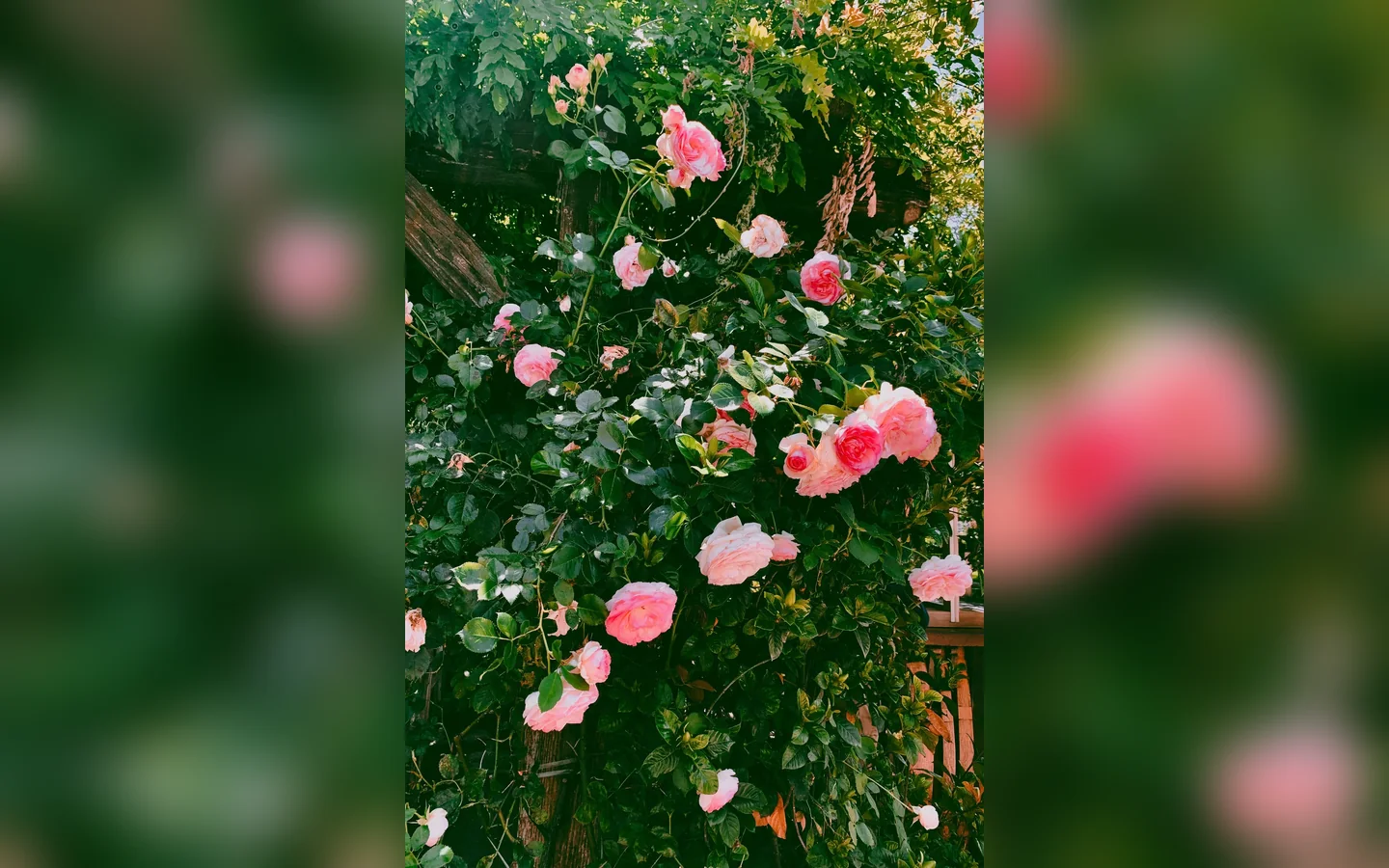
A climbing rose can turn a wall into a mass of flowers, but an untrained plant may become a tall tangle with bare stems below and flowers only at the top. The fix is not to cut everything down to knee height.
Keep a sound framework of long main stems, train suitable growth across the support, and shorten the side shoots that flowered. That's the core of routine climbing-rose pruning.
This article covers the cutting and training technique. Our existing guide to when to prune climbing roses covers the seasonal decision in more detail.
First, is it a climber or a rambler?
A repeat-flowering climbing rose often produces flowers over a long period from summer into autumn. Many rambling roses flower once, on long flexible stems, often around June.
This distinction matters. Most climbing roses are pruned in winter, while once-flowering ramblers are generally managed after flowering in summer.
Look at the variety label and flowering pattern rather than assuming every tall rose is a climber. An established rambling rose cut in winter may lose much of the following summer's flowers.
The framework you are trying to create
Think of a climbing rose as having two kinds of growth:
- Main structural canes: longer vigorous stems tied to trellis, wires or an arch.
- Flowering side shoots: shorter growth emerging from those canes and carrying blooms.
The goal is several well-spaced main stems distributed across the structure, with shorter flowered sides developing along them.
If all the main stems are allowed to shoot vertically, flower buds may concentrate high above eye level. Training the long stems closer to horizontal encourages flowering laterals lower down.
Tools and safety
Use sharp secateurs for young shoots, loppers for thicker branches and a suitable pruning saw for old woody canes.
Wear strong gloves and sleeves; climbing rose thorns can snag clothing and skin.
Check that the trellis, wire and wall fixings can safely carry the plant before pulling stems into position. A rose on a broken support can tear away from a wall in strong wind.
Don't lean a ladder into thorny stems. Use safe access or professional help for growth beyond reach.
Step-by-step winter pruning
- Stand back and identify the healthy long main stems already trained across the support.
- Cut out dead, damaged or diseased growth to healthy wood.
- Remove rubbing, spindly stems that contribute little to the framework.
- Select the strongest new stems needed to fill gaps.
- Tie those new main stems into the support, keeping them as horizontal as practical without snapping them.
- Shorten last year's flowered side shoots by roughly two-thirds, leaving healthy buds.
- Where heavily congested, remove an older poor-flowering main cane from the base to make space.
- Step back, check the framework is balanced and retie any loose stems.
Do not cut all the long main stems to the same short height. You would remove the structure that makes the climber effective.
Where should you make each cut?
Make a clean cut just above a healthy bud or suitable outward-facing shoot, without leaving a long dead stump.
Avoid cutting so close that the bud is damaged. On larger woody stems, use a method that prevents bark tearing and leaves a clean final cut.
Remove dieback to sound tissue. If a rose has several substantial live structural canes, keep enough of them to fill the support.
Clean cutting tools between plants where infection is a concern.
How to train stems horizontally
On a wall, install secure horizontal wires or a suitable trellis with enough room for airflow and maintenance.
Bend flexible new main stems gently to run at an angle or along the wires. Tie them with soft adjustable ties that won't bite into swelling stems.
Don't force an old rigid cane into a tight curve; it may crack. Work with its natural shape or plan a gradual replacement using newer flexible growth.
On an arch, spread stems around the sides instead of letting them shoot straight over the top.
Young climbing roses need less pruning
For a recently planted climber, the priority is establishing long structural canes.
Tie the growing stems in and remove obviously damaged material, but avoid routinely shortening every healthy long shoot.
Once the framework is established and flowering laterals develop, move to the normal winter pruning routine.
See our bare-root rose planting guide for planting depth and establishment requirements.
What if the rose flowers only at the top?
Inspect how the main stems were trained. A tightly upright bundle encourages flowering higher up.
Where stems are flexible, retrain newer healthy growth at a wider angle. In winter, shorten flowered side shoots while maintaining the main framework.
Don't attempt to pull ancient brittle wood down to a horizontal wire; gradual replacement with strong new basal canes is safer.
Renovating an overgrown climbing rose
An old climber may have dead wood, a mass of weak crossing shoots and poor flowering.
Start by removing obviously dead and diseased growth. Retain a manageable group of vigorous stems—often up to six good main canes—and cut out old unproductive wood where the plant has enough replacement growth.
Shorten the remaining side shoots, retie the framework and allow recovery during the next growing season.
A severe renovation can reduce flowering temporarily. For a valuable old rose with one ageing main trunk, proceed cautiously rather than assuming it will reshoot after drastic cutting.
Feeding and care after pruning
In spring, apply a suitable rose fertiliser if needed and mulch with well-rotted garden compost, keeping material away from the crown.
Water newly planted or heavily renovated roses during prolonged dry weather. Established deep-rooted roses may need less frequent watering.
If leaves later show spots or dieback, diagnose the problem separately. Our winter black spot guide explains how to manage infected material.
Common mistakes
- Confusing a once-flowering rambler with a repeat-flowering climber.
- Cutting all main canes short each winter.
- Leaving an entire wall covered in untrained vertical stems.
- Trying to bend old brittle wood sharply.
- Failing to adjust ties as stems thicken.
- Removing every new long cane even when the framework needs renewal.
- Cutting close to a bud or leaving large dead stubs.
How far should I cut back climbing roses?
Generally shorten flowered side shoots by about two-thirds, while retaining and training the strong main structural stems.
Can climbing roses be hard pruned?
Overgrown plants can be renovated, but drastic work may temporarily reduce flowers and should be adapted to the plant's health and existing canes.
Will a climbing rose flower after winter pruning?
Usually yes if it's a repeat-flowering climbing variety and the main framework is retained. Once-flowering ramblers need a different routine.