
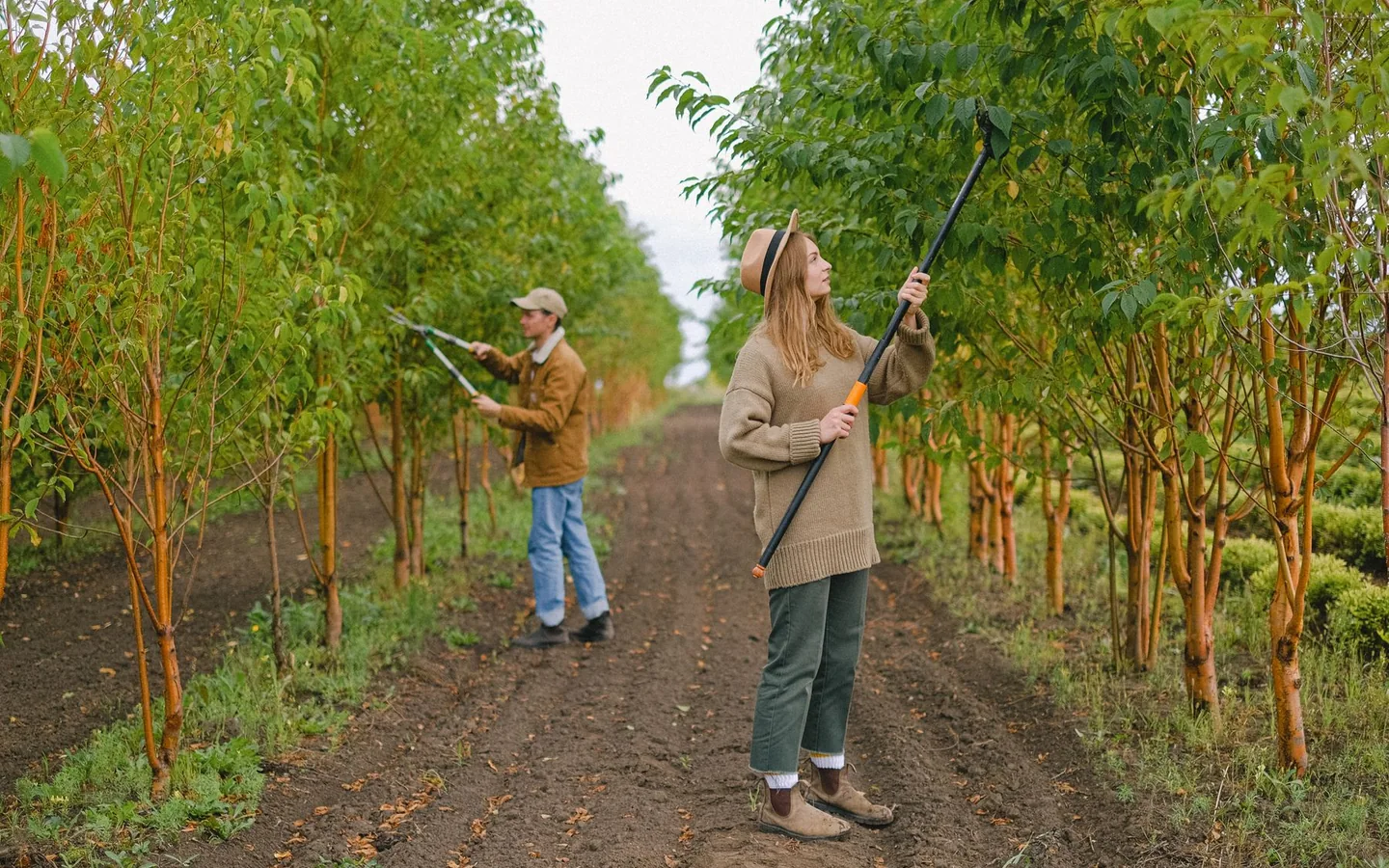
Fruit trees don't all benefit from the same summer haircut. On a trained apple espalier, summer pruning is an important way to maintain shape and encourage fruiting spurs. On a free-standing apple tree, the main structural prune is usually carried out in winter. And plums and cherries are often pruned during spring or summer rather than winter because of their greater susceptibility to silver leaf disease.
Identify the tree and its training system before you remove any shoots. A generic instruction to cut every fruit branch to three leaves can do more harm than good.
Which fruit trees should you prune in summer?
| Tree and form | Usual summer approach | Important distinction |
|---|---|---|
| Apple espalier or cordon | Shorten new lateral shoots in late summer | Maintain permanent trained framework |
| Pear espalier or cordon | Similar method, often earlier than apples | Wait until shoots mature at their bases |
| Free-standing apple or pear | Usually little routine summer pruning | Main maintenance is in winter |
| Plum or gage | Prune in spring or mid-summer as needed | Avoid winter pruning |
| Cherry | Selective pruning in suitable spring/summer weather | Silver leaf and bacterial canker risk |
| Fan-trained peach or nectarine | Summer pruning and tying in after growth | Keep replacement framework shoots |
| Fig | Depends on training system and growth | Don't treat like an apple espalier |
The RHS summer-pruning method for trained apples and pears is not a universal rule for all fruit trees.
Best summer pruning dates in the UK
For trained pears, RHS guidance says pruning often begins in late July once the lower third of current shoots has turned woody.
For trained apples, mid- to late August is frequently suitable, with work occurring around ten days later in northern regions than in the south.
These are signs-based timings, not rigid dates. Cutting too early can encourage unwanted regrowth before winter.
Established plum trees are often pruned in July, while other stone fruit pruning depends on form, health and the dry-weather window.
Why do we summer-prune trained apples and pears?
Espaliers, cordons and other restricted forms need their upright and outward-growing shoots shortened to keep the tree within its support.
This lets more light reach the developing fruit and encourages fruiting spurs close to the permanent branch framework.
Summer pruning is mainly about controlling vigorous new lateral growth, not removing large branches from an otherwise healthy mature tree.
If your free-standing apple has an overgrown crown, follow a suitable winter-pruning plan instead.
How to recognise a shoot ready for pruning
Look for this season's long lateral shoots, often extending more than 20cm from the main framework.
By the correct late-summer stage, the bottom third of a shoot should feel firmer and woody rather than completely soft and green.
The leaves may be dark green and there is usually a cluster of leaves at the shoot's base.
If nearly every shoot is still soft and growing vigorously, it's probably too early for the normal summer shortening method.
How to summer-prune an espalier apple or pear
- Identify the permanent trained arms and leader you intend to keep.
- Tie in useful new framework shoots before cutting anything else.
- Find current-season laterals longer than about 20cm.
- Cut those laterals to three leaves above their basal cluster.
- Shorten shoots arising from existing laterals to one leaf above the basal cluster.
- Leave shorter shoots that already end in a fruit bud unless they create a specific problem.
- Remove or manage vigorous upright growth that spoils the trained outline.
- Step back and inspect light penetration, fruit clearance and overall balance.
These are RHS-trained-tree methods. Use secateurs rather than hedge shears so you can see each bud and leaf cluster.
What if new growth appears after pruning?
If vigorous replacement shoots grow from the cuts, the tree may have been pruned too early or simply be exceptionally vigorous.
The RHS recommends reducing suitable regrowth in September, or later if the original cut was late, often to one leaf beyond the previous cut.
Do not repeatedly cut every new soft shoot at weekly intervals. The tree still needs healthy foliage to support developing fruit.
If regrowth persists, review vigour, rootstock and training method rather than forcing severe summer cuts.
Stone fruit: a different disease risk
Plums, gages and cherries can be vulnerable to silver leaf disease, and inappropriate pruning during winter increases the risk.
RHS advice for plums favours spring for young trees and mid-summer for established ones. For trained stone fruit, choose a dry spring or summer period.
Avoid large unnecessary cuts and use sharp clean tools.
If a branch has suspicious silvered leaves or other disease symptoms, identify the problem rather than spreading it with contaminated equipment.
How to prune trained plums and cherries
A fan-trained cherry or plum should retain its strong permanent framework.
Tie in healthy shoots needed to replace older fruiting wood, then shorten or remove unwanted extension shoots according to the species and fan design.
RHS guidance for some trained stone fruit suggests shortening shoots longer than 20cm, but the length left depends on where the shoot originates.
Never apply apple-and-pear three-leaf rules automatically to every plum or peach.
If the fan is badly overgrown, use species-specific renovation advice or consult an experienced fruit-tree pruner.
Free-standing apples and pears
Established bush and standard apple and pear trees are commonly pruned when dormant, from November to early March.
Summer work may be limited to removing a damaged small shoot, adjusting ties or dealing with a specific problem.
Don't cut large limbs in midsummer just because fruit is difficult to reach.
Our when to prune apple trees guide and when to prune pear trees guide cover these species separately.
Tree size and safety
Use hand secateurs for small shoots and suitably rated loppers or a saw for larger branches.
Don't reach from an unstable ladder while holding a powered cutting tool. A large fruit tree near buildings or power lines needs professional attention.
Check for active bird nests before working in a dense crown.
Avoid tearing bark by pulling large prunings downward through the tree.
Can summer pruning improve fruit colour?
Reducing excessive leaf shade can increase sunlight reaching fruit, supporting ripening and colour in suitable conditions.
But exposing previously shaded fruit to fierce heat can cause sunscald, and removing too many leaves reduces the tree's energy production.
Aim for selective opening rather than stripping the whole tree bare.
A balanced trained framework gives a more reliable long-term crop than a drastic haircut to improve this week's fruit appearance.
Aftercare and fruit load
Check tree ties, wires and stakes so stems aren't constricted by growth.
Water recently planted or container-grown fruit trees during dry spells. An established tree with deep roots may need less assistance.
Remove damaged fruit where appropriate and thin an excessive crop according to species to avoid branch breakage.
Don't feed heavily just after summer pruning to force replacement shoots before winter.
Frequent summer pruning mistakes
- Treating free-standing apples as if they were espaliers.
- Cutting trained apples before their lateral shoot bases are woody.
- Pruning plums in midwinter.
- Removing shoots that should extend a fan framework.
- Stripping too many leaves from ripening fruit.
- Making large unsafe ladder cuts without proper expertise.
- Ignoring disease and nesting birds.
Can I prune my apple tree in July?
For a trained espalier or cordon, summer pruning may begin once shoots mature, often later than July for apples. For a free-standing apple, winter remains the usual main pruning season.
Can you prune plums in summer?
Yes. Mid-summer is often recommended for established plums, ideally in dry weather to reduce disease risk.
Does summer pruning increase fruit?
It can improve light and encourage fruiting spurs on properly trained trees, but results depend on health, variety and correct technique.