
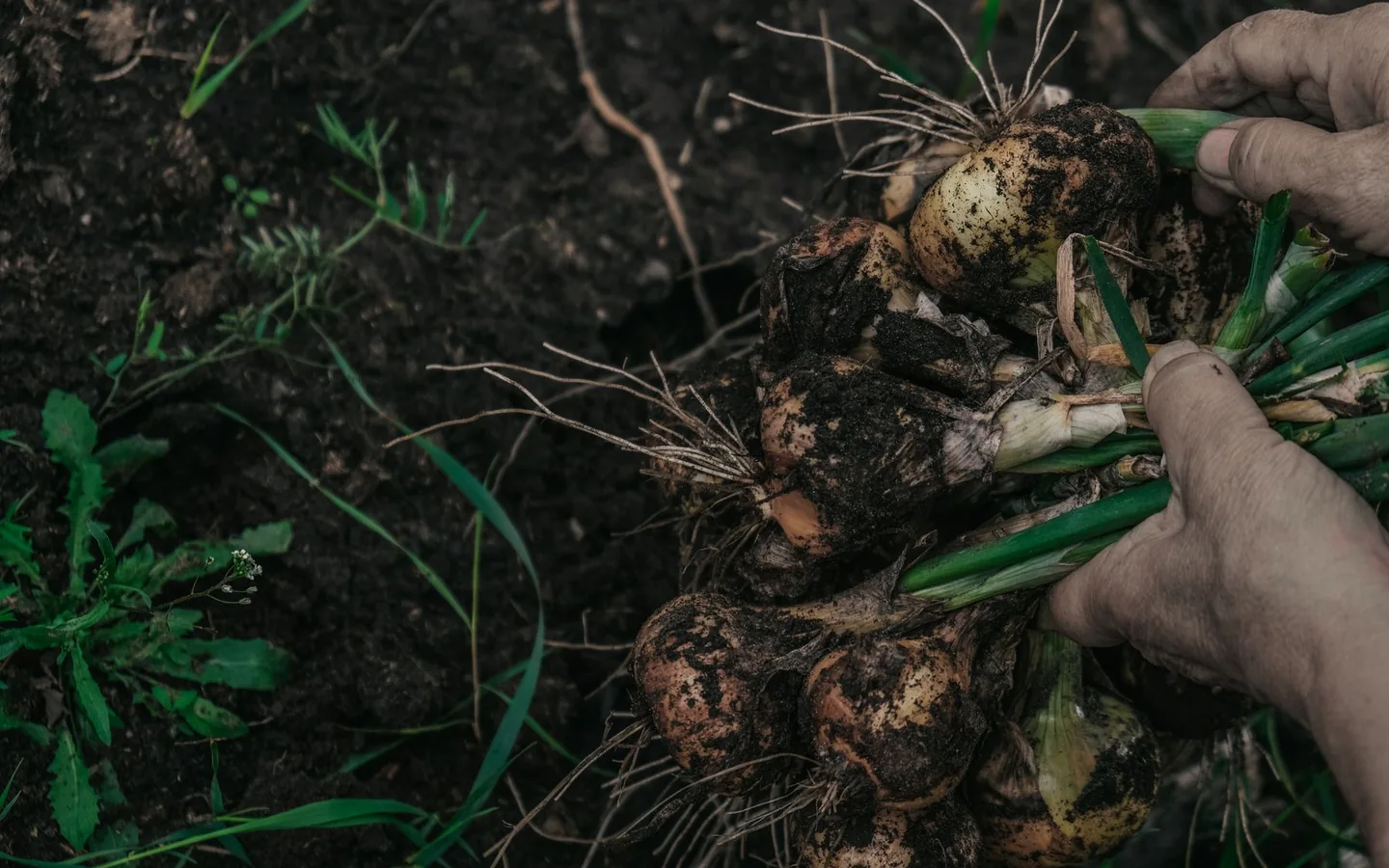
Onions are often ready when they stop looking like healthy growing plants. Their tall green leaves soften, bend over and begin to yellow as the bulb reaches maturity.
For UK gardeners, the main harvest is usually from summer into early autumn, depending on when the crop was planted and its variety. But the tops tell you more than a fixed calendar date. Lifting a crop too green can reduce its keeping quality; waiting in persistently wet soil can encourage rot.
What are the signs of a ripe onion?
Look for a combination of softening, fallen foliage and a bulb that has reached its expected size.
| Sign | What it usually means | What to do |
|---|---|---|
| Most tops bend over naturally | Bulb growth is nearing completion | Begin checking maturity |
| Leaves yellow and dry | Growth has slowed or stopped | Prepare for lifting |
| Neck becomes soft, then dries | Bulb entering curing stage | Avoid unnecessary watering |
| Bulb reaches mature size | Potentially ready, if leaves agree | Check several plants |
| One leaf suddenly wilts | Could be damage or disease | Investigate before harvesting all |
| Thick green neck remains upright | May still be growing or poorly matured | Give sound plants more time |
A large bulb is not necessarily a fully mature storage onion. The dry papery outer skins and neck develop properly during and after ripening.
UK onion harvest months
Autumn-planted onions and overwintered sets often mature around June or July.
Spring-planted sets and onions raised from seed commonly mature July through September, depending on the cultivar and weather.
A very cold spring can delay harvest. An early warm season may bring the crop forward.
Don't try to force every onion out in July just because a seed catalogue says it is a summer crop.
Why do onion leaves fall over?
As the onion finishes forming its bulb, the neck loses rigidity and the leaves naturally flop sideways.
This is a more useful maturity signal than a certain number of days after planting.
Some varieties topple more uniformly than others. If most of a row has collapsed but a handful remain green, you can lift mature bulbs first and inspect the remaining plants separately.
Don't deliberately bend healthy upright tops over to imitate ripeness. Damaging active leaves can interrupt growth and create an entry point for decay.
When should you stop watering?
Once the crop is naturally yellowing and approaching harvest, reduce unnecessary irrigation.
You don't need to make the soil bone dry months beforehand. Bulbs still growing during spring may need moisture in a drought.
In a prolonged wet spell, natural rainfall may keep the soil moist despite your efforts. Lift sound ripe bulbs when conditions allow instead of letting them sit in saturated ground.
Poor drainage cannot be fixed by simply reducing how often you use a watering can.
How to test a handful of bulbs
Choose several onions from different parts of the bed.
Check that the majority have naturally fallen foliage, substantial bulbs and no active-looking thick green necks.
Gently loosen a representative bulb with a fork and inspect the roots, base and wrappers.
A soft, foul-smelling bulb isn't a signal that all onions are ready—it may be diseased. Dispose of that bulb appropriately and check its neighbours.
Lifting onions without damage
- Choose a dry period when possible.
- Use a garden fork or hand fork to loosen soil near the roots.
- Lift the bulbs carefully rather than wrenching them by the leaves.
- Shake off loose soil without banging bulbs together.
- Keep the foliage attached while the necks are still fresh.
- Set aside any cut, soft or visibly diseased bulbs.
- Move sound bulbs to a dry airy place for curing.
- Label different varieties if you intend to compare keeping quality.
A nick from a fork may not show immediate decay, but it can ruin an onion during storage.
Is it safe to leave mature onions in the soil?
A brief delay in reasonably dry ground is often harmless, but don't leave ripe onions for weeks through heavy rain.
Moisture can encourage bulbs to reshoot or develop neck rot, especially if they have started opening at the neck.
Onions that start making fresh green growth after maturity will generally be poorer for long-term storage.
If the forecast turns persistently wet when most tops are down, lifting the crop and drying under cover is sensible.
What if it rains on harvest day?
You can lift onions in less-than-perfect weather if the crop is at risk, but the drying process becomes more important.
Spread bulbs in a well-ventilated sheltered place, ideally on mesh or slatted trays that allow air beneath.
Don't pile wet onions into a closed sack or plastic tub.
A greenhouse can help during wet weather, but ventilate carefully to avoid condensation and extreme daytime heat.
How long does it take to dry onions?
The RHS recommends about two weeks of drying after harvest, although humid weather may require longer.
The neck and foliage should be papery dry before long-term storage.
This article is about choosing the right harvest moment. Our separate onion storage guidance covers container choices, sprouting and long-term quality in more detail.
For any harvested crop, a properly ventilated drying space is more important than forcing it into storage before the skins are sound.
What about onions that have bolted?
Bolting means the onion has formed a flowering stalk prematurely.
That bulb may still be usable, but bolted onions generally don't store as reliably. Use them ahead of the main crop.
Don't remove a seed stalk and assume the onion will return to producing an ideal storage bulb.
Bolting can be associated with temperature stress and variety susceptibility.
Thick-necked onions
A thick green neck may indicate a bulb that hasn't matured well. Those onions are more susceptible to neck rot in storage.
Separate them from your best keepers and use them sooner, provided they are otherwise sound.
If thick necks are widespread, review excessive nitrogen use, variety and harvest timing.
The RHS notes that high nitrogen and late maturity can increase neck-rot problems.
What if only half the row is ripe?
Lift ready bulbs individually, especially if the row contains different varieties or patches with varying moisture.
Continue watching the remaining plants for natural leaf collapse.
Avoid unnecessary digging that damages bulbs still developing nearby.
A staggered harvest is fine in a small garden; commercial mechanical harvesting rules don't always make sense for twenty onions.
How to use freshly harvested onions
A freshly lifted onion can be cooked soon after harvest if it is sound and clean.
For longer storage, sound bulb skins and a properly dried neck make a significant difference.
Use damaged but otherwise edible bulbs promptly rather than storing them in the best crate.
Never use bulbs with obvious mould, soft wet rot or an unpleasant smell.
Prepare the empty bed for the next crop
Once onions are out, remove obvious diseased debris and assess what you might sow next.
A suitable late-summer salad or green manure may keep the space productive.
Don't plant another allium crop repeatedly into soil known to have white rot or serious onion diseases.
Our soil preparation guide covers soil structure; avoid digging wet heavy clay simply because the bed is empty.
Common onion harvest mistakes
- Harvesting only by calendar date rather than plant maturity.
- Forcing upright onion tops to fall over.
- Pulling hard enough to tear the neck.
- Leaving mature bulbs in saturated soil for weeks.
- Piling freshly wet onions into sealed plastic.
- Storing thick-necked or bolted bulbs with the best keepers.
- Mistaking sudden disease collapse for uniform ripening.
What month are onions harvested in the UK?
Often June–July for autumn-planted crops and July–September for spring-planted crops. Plant maturity is the deciding factor.
Should every onion leaf be brown before lifting?
No. Most foliage should be naturally falling and drying, but waiting until every leaf disappears can expose bulbs to needless wet weather.
Can you eat onions straight after harvesting?
Yes, sound onions can be used fresh. Drying and curing matter mainly for extended storage.
For calculating how much growing space your next crop will need, the plant spacing calculator provides a starting point.