
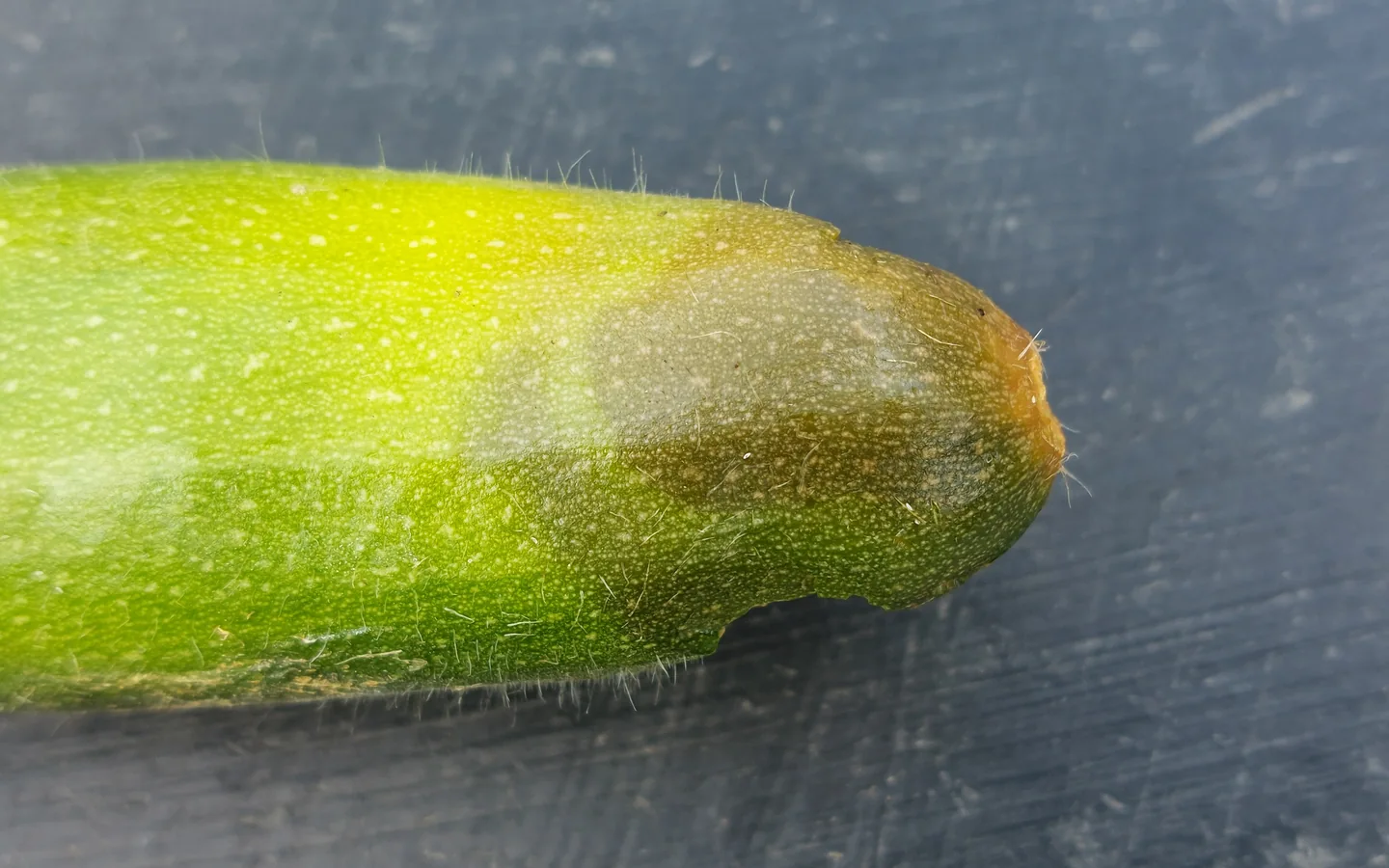
It's frustrating to see a tiny courgette behind a flower, only for the end to yellow, soften and rot before the fruit becomes large enough to pick.
In early summer, this often isn't an infection moving through the patch. Poor pollination and unsuitable growing conditions can cause immature courgettes to abort. The little fruit stops growing and begins to decay.
However, you should check the entire plant before assuming every rotten fruit has the same cause.
What does the problem look like?
| Symptom | Likely explanation | First thing to inspect |
|---|---|---|
| Tiny fruitlet yellows and rots at flower end | Failed fruit set or plant stress | Pollination, temperature and plant maturity |
| New fruit stays small during chilly weather | Growth slowed by cool conditions | Night temperatures |
| Large fruit has an isolated dark sunken end | Physiological disorder or damage | Moisture consistency and fruit condition |
| Several fruits develop spreading soft mould | Wet conditions or decay organisms | Airflow, hygiene and affected tissue |
| Entire plant wilts with wet soil | Possible root damage | Drainage and root health |
| Only early fruits fail, later ones succeed | Young plant may not sustain fruit | Plant size and subsequent flowers |
The RHS specifically identifies small courgettes that yellow or rot in cool early summer as a common consequence of inadequate pollination or weak plant establishment.
Courgette flowers explained
Courgettes produce male and female flowers on the same plant.
The female flower has a miniature courgette immediately behind the petals. The male flower sits on a plain stalk without a swelling.
Pollen normally needs to reach the female flower for successful fruit development in ordinary varieties.
A plant may initially produce many male flowers before there are sufficient female flowers. That is usually normal.
Why poor pollination makes fruitlets rot
If a female flower isn't pollinated effectively, the attached fruitlet may begin swelling briefly, then stop developing.
As it aborts, the blossom end can shrivel and become soft.
Cold, dull and rainy weather reduces the activity of bees and other pollinators, so this often happens during an unsettled early summer.
One spoiled courgette doesn't mean you need to remove the healthy plant.
How to hand-pollinate a courgette
When flowers are freshly open, often in the morning:
- Find a healthy male flower with a visible pollen-bearing centre.
- Find a freshly opened female flower with a tiny fruit behind it.
- Gently remove the male petals without damaging the centre.
- Touch the pollen-bearing portion to the female flower's stigma.
- Transfer pollen carefully across the receptive surface.
- Repeat for other open female flowers if necessary.
- Avoid tearing petals or snapping supporting stems.
- Leave the young fruit attached and watch whether it develops normally.
A soft clean artist's brush can be used instead of detaching the male flower.
If no male flowers are open, wait for a suitable day rather than trying to force pollination with a closed flower.
Sometimes the plant is simply too young
A tiny courgette plant with only a few leaves may not have enough stored resources or root capacity to support fruit.
It may produce an early flower but abort the first developing fruit.
Give the plant time to build healthy leaves and roots in good growing conditions.
Don't apply several heavy fertiliser doses to make a small plant fruit immediately. Excess feeding can cause further imbalance.
Why cold nights cause poor fruit development
Courgettes are tender and prefer warm growing conditions.
A run of cold, wet nights can slow growth even after frost danger appears to have passed.
If you've planted in an exposed northern bed, the first fruits may fail while the weather remains chilly.
Provide reasonable shelter from cold winds and avoid planting seedlings before soil is suitably warm.
For next season, our seed-starting indoors guide helps time tender plants to avoid an unnecessarily early outdoor start.
Can too much water cause rot?
Yes, indirectly and sometimes directly.
Courgettes need ample moisture as leaves and fruit develop, but persistently saturated soil deprives roots of oxygen.
A plant with damaged roots cannot take up water and nutrients reliably even when soil appears wet.
Check the root zone rather than pouring more water onto every yellowing fruitlet.
A pot without sufficient drainage or a low clay bed that floods after rain is a problem to correct.
What about drought?
Courgettes have large leaves and can lose substantial amounts of moisture in hot dry weather.
Severe drought during flowering and fruit development can cause stress and fruit abortion.
Water at root depth as needed. Avoid repeated cycles of bone-dry soil followed by flooding.
Mulch established plants when the soil is moist, keeping wet material away from their crowns.
Our garden irrigation planning guide explains why slow root watering is more effective than wetting the whole leaf canopy.
Should you remove rotten courgettes?
Yes. Snip off small rotting fruitlets and dispose of them appropriately.
Don't leave soft fruit against stems where decay can spread or attract pests.
Use clean secateurs, especially if tissue is badly diseased.
Be careful not to remove healthy female flowers that are still enlarging.
Is it blossom-end rot?
Not every rotten courgette end has the same cause.
Blossom-end rot is best known in tomatoes and peppers, but fruit-end damage can occur in other crops. Water and nutrient movement can be involved.
For very small courgettes rotting immediately after flowering in cool weather, failed pollination is often the more likely first explanation.
Don't assume that adding crushed eggshells or calcium tablets will fix a lack of pollen or cold nights.
Mould on a larger courgette
A mature fruit that develops spreading wet rot or fuzzy fungal growth has a different problem from a newly aborted fruitlet.
Remove the diseased fruit and inspect neighbouring plants and soil for persistent wetness and poor airflow.
Don't eat fruit that is soft, mouldy or foul-smelling.
If large sections of the plant wilt or stems soften, investigate disease and root damage rather than focusing only on flowers.
Encourage reliable pollination
Grow a range of nectar flowers nearby to attract insects through the summer.
Avoid spraying insecticides around open courgette flowers without a justified, label-compliant reason.
Don't keep flowers permanently closed under mesh unless pollination is provided or the specific cultivar permits it.
If plants need insect protection, consider whether the covers must be opened once flowering begins.
Harvest mature fruits frequently
Courgettes are usually best picked young, at around 10–12.5cm for many ordinary varieties.
If you leave several giant marrows on the plant, it may direct resources towards those mature fruits rather than new ones.
Check every few days and pick with a knife or secateurs instead of tugging on stems.
Regular harvesting helps maintain a productive crop.
A simple troubleshooting order
First: examine whether the failing fruit is a tiny aborted fruitlet or a larger rotten courgette.
Second: check flower type, pollinating insects and the week's weather.
Third: inspect root moisture and drainage.
Fourth: assess plant age, nutrition, leaves and any spreading disease.
Then: remove decaying fruit and improve the actual cause rather than trying several different fertilisers and sprays at once.
Bitter courgettes are a separate safety issue
An unusually bitter courgette may contain elevated cucurbitacins, naturally occurring compounds that can cause serious gastrointestinal symptoms.
Do not eat bitter courgettes, even if the fruit otherwise appears healthy.
Discard affected fruit and avoid saving seed from an unusually bitter plant.
Don't assume bitterness is cured by cooking or strong seasoning.
Common mistakes
- Removing a healthy courgette plant because its first fruitlet aborted.
- Adding calcium products before checking pollination.
- Keeping plants in saturated soil.
- Waiting for fruitlets to become mouldy before removing them.
- Spraying flowering plants and discouraging pollinating insects.
- Leaving huge overmature courgettes attached.
- Eating fruit with a distinctly bitter taste.
Why do courgettes rot at the flower end?
Often because an immature fruit wasn't pollinated properly or the young plant was stressed during cool weather.
Will hand pollination help?
It can help ordinary courgettes when bees are inactive and both male and female flowers are open at the same time.
Can you eat a courgette with a rotten end?
Discard fruit with substantial decay, mould or an off smell. Don't eat intensely bitter courgettes.
For the general principles of container drainage, see our pot compost guide.