
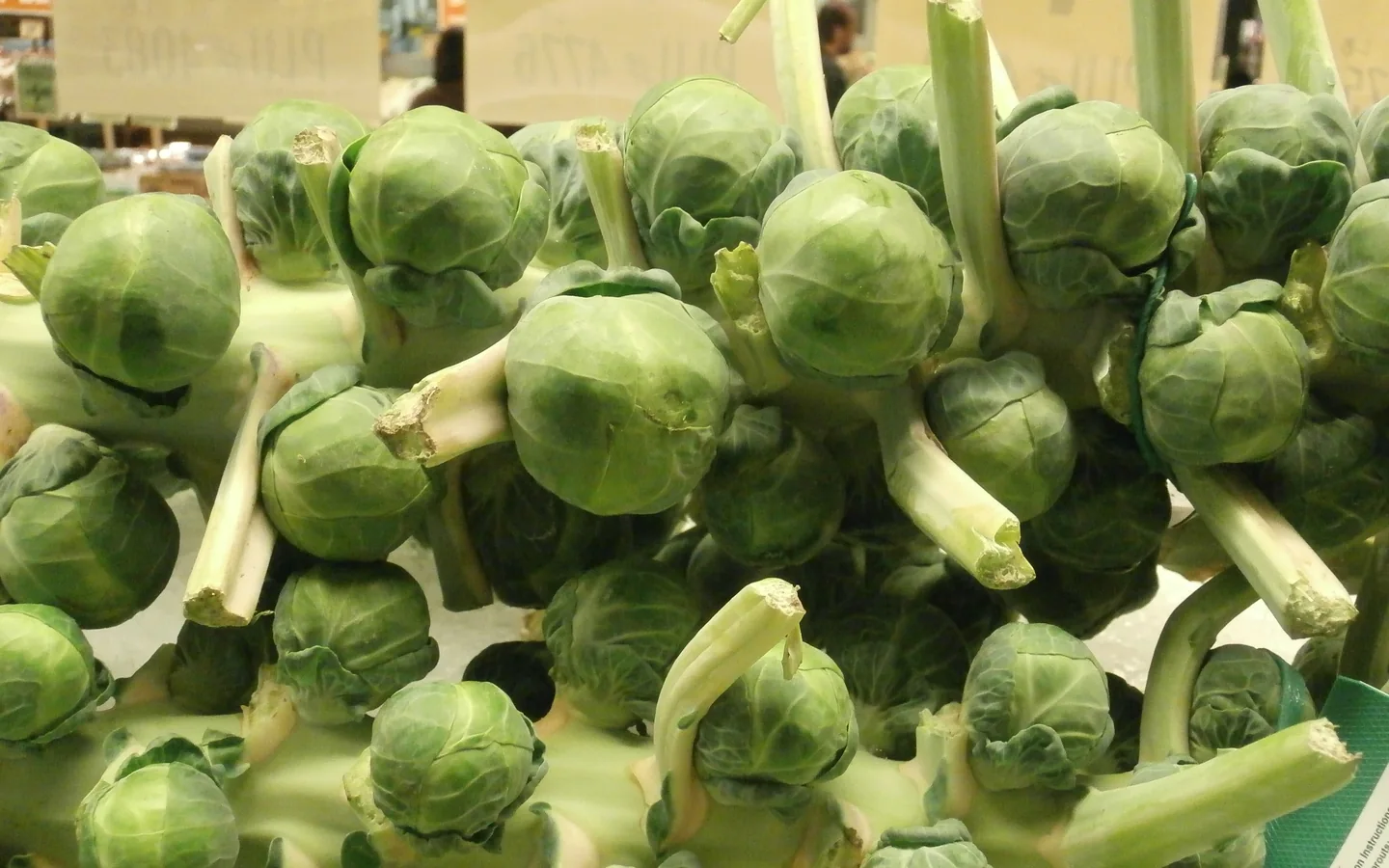
Brussels sprouts are a long-game vegetable. You sow in spring, give the plants space for months, and harvest the little green buds along their stems during autumn and winter.
The challenge is not keeping them alive through ordinary UK cold. They are hardy. It's getting them well rooted, firmly planted and protected from insects and birds while their tall stems develop.
Choose a variety for your harvest dates
Some Brussels sprout varieties mature earlier in autumn, while others are bred for Christmas and late-winter picking.
If you have room for only a couple of plants, choose a dependable mid- or late-season type that matches when your household actually eats sprouts.
Modern varieties often form tighter sprouts and have better flavour than older types remembered from childhood. Green sprouts are traditional, but purple or red varieties are also available.
Look for disease resistance, particularly clubroot resistance if you have a history of brassicas struggling in that soil.
How long do Brussels sprouts take?
They are a relatively slow-growing crop, often occupying the ground from spring until late autumn or winter.
Don't plan to squeeze them into a narrow gap as a quick summer catch crop. Mature plants often reach about 90cm tall or more and need room to grow outward.
The long season is one reason it's useful to start seeds in modules or a separate seedbed, then transplant when the main plot becomes available.
When to sow Brussels sprouts in the UK
You can sow indoors from February to April if you have enough light, or outdoors from roughly March to May, using suitable protection in cold weather.
For early sowings, use a cold frame, unheated greenhouse or bright indoor growing space with suitable temperatures. Avoid leaving seedlings in a dark room simply because it is warm.
A late sowing may not have enough season left to form useful winter crops, particularly in exposed northern areas.
Follow the variety's sowing instructions and match your sowing to the planned harvest period.
Sow seedlings in modules
- Fill cells with fresh peat-free seed compost and moisten it.
- Sow one or two seeds per cell around 2cm deep.
- Keep moist without waterlogging.
- Give seedlings bright light as soon as they emerge.
- Thin each cell to one healthy plant.
- Grow on until plants have sturdy stems and a good root system.
- Harden off before moving outside.
- Protect young plants against slugs and other early pests.
Our seedling hardening-off guide helps move protected young plants outside without a sudden shock.
Starting plants in an outdoor seedbed
Brussels sprouts can be sown into a nursery bed rather than occupying their final wide-spaced positions from the start.
Prepare a fine, firm, weed-free seedbed and sow about 2cm deep in short rows.
Thin seedlings so they don't become an unmanageable tangle. Protect the young leaves with suitable mesh and inspect for pests regularly.
When maincrop peas, salads or early vegetables finish, the sprout seedlings can be moved to their final places.
This makes good use of limited spring garden space.
Why firm soil matters
Brussels sprouts develop tall stems carrying heavy foliage and buds. If roots are planted in freshly dug, loose soil, wind can rock them and damage the root system.
Choose a sunny sheltered site with fertile, well-drained soil. Improve poor soil in advance with mature compost.
Firm around the planting hole when you set out each seedling, and check the plants after strong winds.
If soil is very acidic, a measured pH test is worthwhile. Clubroot is more likely in acidic brassica ground, though raising pH alone does not cure an infected bed.
Our soil pH guide helps interpret a test rather than applying lime without evidence.
Planting out in late spring or early summer
Move plants to their final bed when they are roughly 10–15cm tall and strong enough to handle, after suitable hardening off.
Plant more deeply than they grew in the nursery, with the lowest leaves close to the soil surface. Firm the soil well and water.
Space plants approximately 60cm apart in both directions. This may look generous with tiny seedlings, but it allows their mature leaves to spread.
A crowded planting encourages poor airflow and makes harvesting harder. Our plant spacing guide helps plan for mature size.
Protect against pigeons and caterpillars
Brussels sprouts belong to the brassica family, so cabbage white caterpillars can damage leaves during the growing season.
Fine insect-proof mesh on a secure frame helps exclude butterflies. Make sure the cover doesn't become tight around growing plants.
Later in autumn and winter, pigeons can strip foliage from tall stems. Fit suitable wildlife-safe netting and check it after wind.
Our guide to protecting brassicas from pigeons covers careful netting and ways to avoid trapping wildlife.
Watering and mulching
Newly transplanted Brussels sprouts need consistent moisture while roots establish.
After that, water thoroughly during prolonged dry spells, particularly if the soil is sandy or summer has been unusually hot.
Use a mulch of mature compost to conserve soil moisture and limit weed competition.
Don't leave stems buried under a damp pile of mulch, and avoid keeping heavy soil permanently saturated.
Feeding sprouts responsibly
Well-prepared fertile ground generally supports steady growth. Too much nitrogen isn't a guaranteed route to bigger sprouts.
Very leafy growth without tight buds may be influenced by variety, temperature, planting density or growing conditions.
If plants are weak, examine roots and moisture before applying fertiliser. Old lower leaves naturally yellow and fall as plants age.
Apply extra feed only when the soil or plant condition indicates a need.
Supporting tall plants in windy gardens
A tall sprout plant can rock badly in an exposed position. If the stem is moving at ground level after storms, firm the soil and add support.
Use a substantial stake and a loose tie that doesn't rub or cut into the stem as it thickens.
Consider low-growing or compact varieties for especially windy gardens. A solid sheltered site is preferable to relying on a tall cane alone.
Avoid tying the whole plant too tightly; leaves and stems need room to move without breaking.
How do sprouts develop?
Each sprout forms from a bud in the angle between a leaf stalk and the main stem.
As the plant matures, small rounded sprouts develop along the stem, often becoming ready from the bottom upwards.
Removing healthy foliage indiscriminately doesn't necessarily improve the crop. Leaves are important for photosynthesis while buds develop.
Some older lower leaves naturally yellow and can be removed when they are no longer useful.
When to harvest Brussels sprouts
Start picking when sprouts are firm, bright and tightly closed, commonly from autumn into winter depending on variety.
Many gardeners prefer them after a frost, when flavour may become sweeter.
Take the lowest mature sprouts first and move gradually up the stem. Hold the stalk and snap or cut the sprouts cleanly without damaging adjacent buds.
If a modern variety matures uniformly, you may also harvest the entire stem at once.
Don't let sprouts become loose and yellow in the belief that larger always means better.
Can Brussels sprouts grow in pots?
Yes, but use a compact variety and a stable container. One plant in a pot of at least 30cm diameter is a sensible starting point for a suitable cultivar, though larger pots are easier to keep watered.
Use good peat-free compost and secure the pot against wind.
Container plants depend on you for water and nutrients for a long period, including during autumn when growth slows.
Our pot compost calculator helps work out the amount needed.
Why are my sprouts loose or 'blown'?
Loose, leafy sprouts may result from temperature, cultivar, excessive nitrogen, poor spacing or erratic growing conditions.
Some varieties naturally produce different bud shapes, so examine several plants rather than judging one sprout.
Once buds are large and blown, they won't reliably tighten into ideal firm sprouts later. Harvest usable portions and improve next year's growing conditions.
Aim for correct spacing and steady growth from the beginning instead of applying a last-minute treatment.
Other common problems
Holes in leaves: check for cabbage white caterpillars and slugs.
Plants lean after wind: inspect root anchorage and stake if necessary.
Swollen distorted roots: clubroot may be present; don't move contaminated soil around the plot.
Leaves turn purple or yellow: colour changes can come from variety, stress or nutrient and root problems. Diagnose before feeding.
Sprouts turn brown or rot: harvest sound buds promptly and discard decayed material.
Looking after the crop through winter
Brussels sprouts tolerate cold well, but snow and wind can damage tall plants or netting.
Check frames and stakes after storms. Keep the base of plants clear of heavy rotting debris.
Harvest as required while the sprouts are sound and tight. Some plants also provide useful young leafy tops near the end of cropping.
Once the crop is finished, clear stems and plan a different crop family for that bed in the next rotation.
Quick answers
Can you grow sprouts for Christmas? Yes, select an appropriate mid- or late-season variety and sow in the recommended spring window.
How many plants do you need? A few healthy plants can provide a useful family crop because many buds form on each stem.
Can sprouts survive frost? Established plants are hardy and often crop well through winter.
Why are my plants all leaves? They may still be growing, or site and variety conditions may be reducing bud development.
Grow fewer sprouts properly spaced, keep them firm and protected, and let the long season do its work. The winter harvest is the result of careful spring planting.