
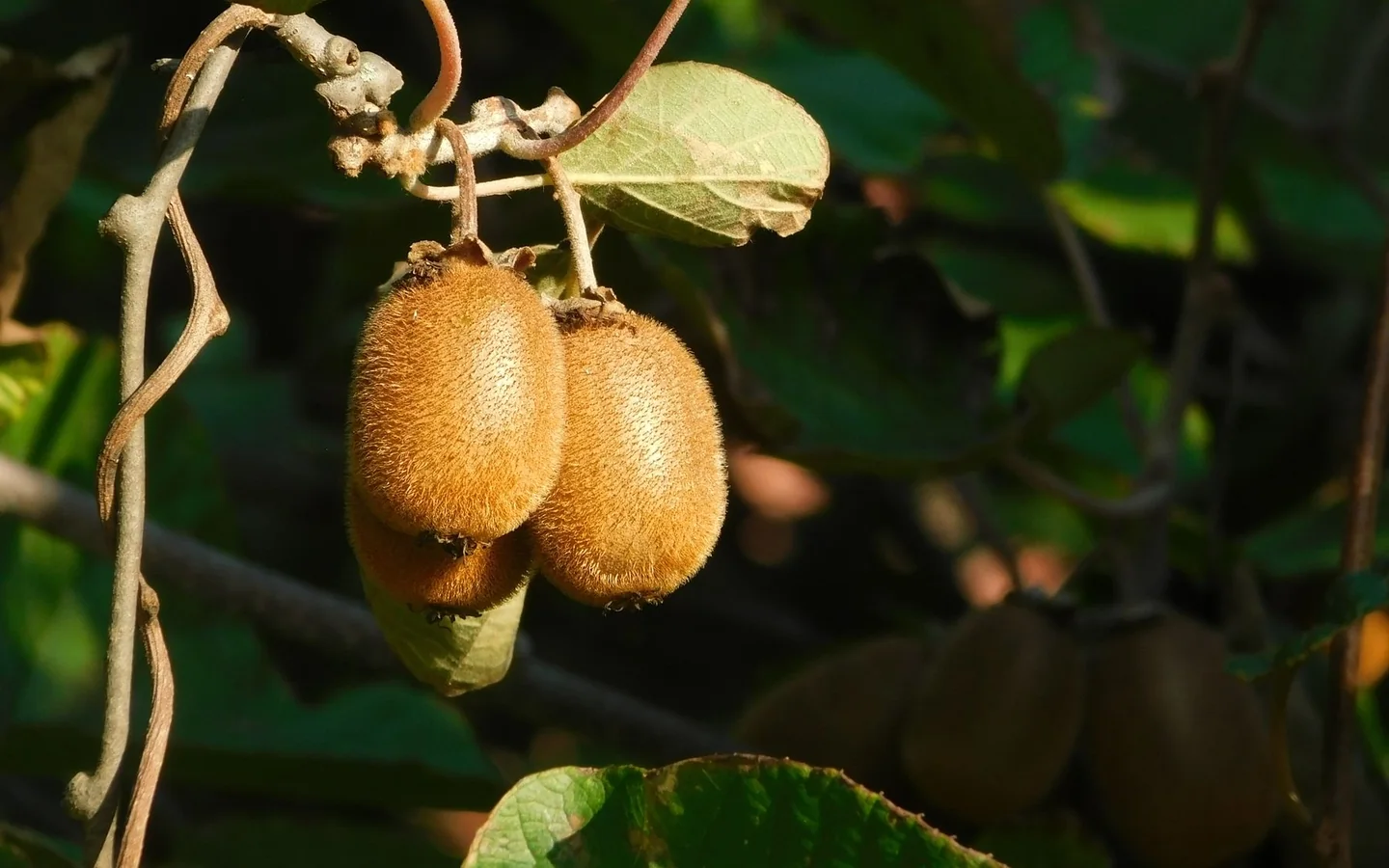
Kiwifruit seems like an unlikely British garden crop, yet certain varieties can grow and fruit here. The plant itself is often hardy enough to survive ordinary winter cold; the harder part is getting a long enough warm season for the fruit to ripen.
There is another trap when buying: some kiwi vines are male, some female and others self-fertile. A vigorous plant with flowers may never produce a kiwi if the pollination arrangement is wrong.
Kiwi fruit or kiwi berry?
Two groups are particularly relevant to UK gardeners.
Actinidia deliciosa produces larger fuzzy-skinned kiwifruit like those sold in supermarkets. It needs a very warm, sheltered position and a relatively long ripening season.
Actinidia arguta, often called kiwi berry or hardy kiwi, produces smaller smooth-skinned fruit. Some cultivars are more adaptable to cooler conditions, although they still benefit from warmth and shelter.
A third species, Actinidia kolomikta, is often grown mainly for its colourful foliage rather than a substantial fruit crop.
Choose for your space and climate. A small kiwi berry vine can be more realistic than expecting supermarket-sized fruit on a cold north-facing wall.
Male, female and self-fertile plants
Many kiwi varieties are dioecious: male and female flowers occur on separate plants. A female vine needs compatible pollen from a male or suitable self-fertile cultivar flowering at the same time.
Male vines produce flowers but no fruit. A self-fertile variety can crop on its own, though its productivity depends on conditions.
Check the label carefully:
| Variety example | Fruit type | Pollination |
|---|---|---|
| 'Jenny' | Fuzzy kiwifruit | Self-fertile |
| 'Hayward' | Large fuzzy fruit | Female; needs compatible pollen |
| 'Tormuri' | Pollinator | Male; no fruit |
| 'Issai' | Small smooth kiwi berries | Self-fertile |
| 'Ken's Red' | Small reddish kiwi berries | Female; needs a compatible male |
If you have room for one vine, buy a cultivar clearly described as self-fertile rather than hoping an unlabelled plant can fruit alone.
How big will a kiwi vine become?
Bigger than many buyers expect. Kiwi vines are vigorous woody climbers with large leaves and can eventually spread several metres.
A permanent structure such as sturdy horizontal wires, a pergola or a strong trellis is essential. Lightweight decorative netting can collapse under mature growth.
Don't plant a kiwi beside a narrow gate and expect to keep it tidy without pruning.
Allow enough room to reach fruit and carry out maintenance safely. Consider access to neighbouring property and roof gutters before choosing the position.
The best site for a UK kiwi
Choose the warmest sunny sheltered position available, ideally a south- or southwest-facing wall.
The soil should be fertile, reasonably moisture-retentive and able to drain. Kiwi plants dislike waterlogged roots and prolonged drought.
Avoid frost pockets. A vine may survive winter yet lose tender new spring shoots to a late frost, delaying or removing that season's crop.
In northern England, expect a more challenging ripening season than in a warm sheltered southern site. A cool summer can leave fuzzy kiwifruit under-ripe outdoors.
When and how to plant a kiwi
Container-grown plants can be planted during suitable mild conditions, with spring or autumn usually convenient.
Prepare the trellis first. Dig a hole wide enough for the rootball and set the plant at about the same depth it was growing in its pot.
Backfill with suitable soil, firm gently and water. Don't bury the stem deeply.
Mulch the surrounding soil to conserve moisture, leaving a gap at the base. Keep competing weeds and grass away from the young root area.
Our soil preparation guide covers poor ground and why wet clay should not be worked while saturated.
Training the young vine
Guide one strong stem towards the main wire or support. Once it reaches the desired height, train lateral shoots along the framework.
Over the following seasons, form a permanent structure that can carry fruiting shoots without a dense knot of stems.
Tie shoots loosely with material that won't cut into the bark. Check ties regularly because vines thicken rapidly.
Do not allow an untrained vine to climb into a roof or an old fence panel that cannot carry its weight.
Why kiwi vines need pruning twice a year
Pruning controls vigour and encourages fruitful shoots while keeping the canopy open.
Winter pruning sets the structure and removes unsuitable growth while plants are dormant.
Summer pruning shortens overlong new shoots, improves light and directs energy towards developing fruit.
The details differ with the training system and cultivar. Don't blindly cut every shoot to an arbitrary length; identify fruiting wood and permanent framework first.
Watering and feeding
Young plants need reliable moisture while their roots establish. During dry summer spells, check soil moisture and water thoroughly when needed.
Established vines have a larger root system but can still suffer drought while carrying fruit. Containers dry much faster.
Apply a modest balanced feed where soil conditions warrant it. Too much nitrogen can produce a thicket of leaves with relatively little fruit.
Use mature compost as a mulch if the soil needs it; avoid leaving wet organic material against the trunk.
Can kiwi be grown in pots?
It is possible with careful management, but vigorous kiwi vines are not naturally small container plants.
Choose a very large stable pot, a suitable compact or controllable cultivar and a permanent support. Monitor moisture daily during hot weather.
A pot-grown plant requires more watering and feeding than one with roots spreading through garden soil.
Our pot compost calculator helps estimate compost for large tubs, but choosing a realistic cultivar remains just as important.
Flowers but no fruit?
Start with the cultivar label. A male vine cannot produce fruit, and a female plant without suitable pollen often won't set a crop.
Even with compatible plants, flowering must overlap. Poor weather can reduce pollinator activity.
Late frost can destroy flower buds or young shoots before you notice the problem.
Young vines also take time to mature. Kiwi plants often need three or four years before useful cropping begins.
Don't apply extra feed until you've checked sex, age, flowering and site conditions.
How long does the fruit take to ripen?
Fruit develops over summer and often remains on the vine into autumn.
Large fuzzy kiwifruit needs a particularly warm season, and in Britain it may not fully ripen outdoors even when the plant is thriving.
Pick mature fruit before a hard frost, then ripen it indoors if necessary. It may take weeks.
Small kiwi berries can ripen earlier depending on the cultivar; don't use the same harvest date for all Actinidia types.
Harvesting and ripening indoors
Use clean secateurs or lift fruit carefully to avoid bruising. Keep the harvested fruit in a single layer at room temperature for ripening.
A ripe large kiwi should yield slightly to gentle pressure and have the flavour expected of the variety.
If you need to speed up ripening, keep some fruit near ripe apples or bananas; ethylene from the other fruit can encourage ripening.
Once ripe, refrigerate and eat promptly. Damaged or mouldy fruit should be discarded.
Protect young spring shoots
The most vulnerable period may be spring, not midwinter. Tender emerging shoots can be blackened by a late frost.
For a small young vine, apply suitable fleece temporarily when frost is forecast, securing it without crushing growth.
Remove protection when conditions improve, maintaining air circulation and pollinator access.
Our frost protection guide explains breathable covering methods.
Common kiwi problems
Lots of growth but no fruit: check whether the plant is male, too young, incorrectly pollinated or in deep shade.
Leaves blacken in spring: late frost may have damaged tender shoots.
Fruit stays hard into November: the season may be too cool for full outdoor ripening.
Roots suffer in winter: investigate persistent waterlogging rather than applying more fertiliser.
Vine grows across every support: adjust summer and winter pruning.
Flowers appear at different times: male and female varieties may not have overlapping pollination windows.
Quick answers
Can kiwifruit grow outdoors in the UK? Yes, with suitable varieties and a warm sheltered site, although crop ripening varies greatly by region.
Do you need two kiwi plants? Not if you choose a correctly labelled self-fertile cultivar.
Are kiwi berries easier? Some are hardier and smaller-fruited, but still require sun, a sturdy support and correct pollination.
How many years until fruit? Commonly three or four, with considerable variation.
Choose a cultivar that suits your garden, confirm how it is pollinated and give the vine room. The difference between an ornamental kiwi and a useful fruit crop often begins with those three decisions.