
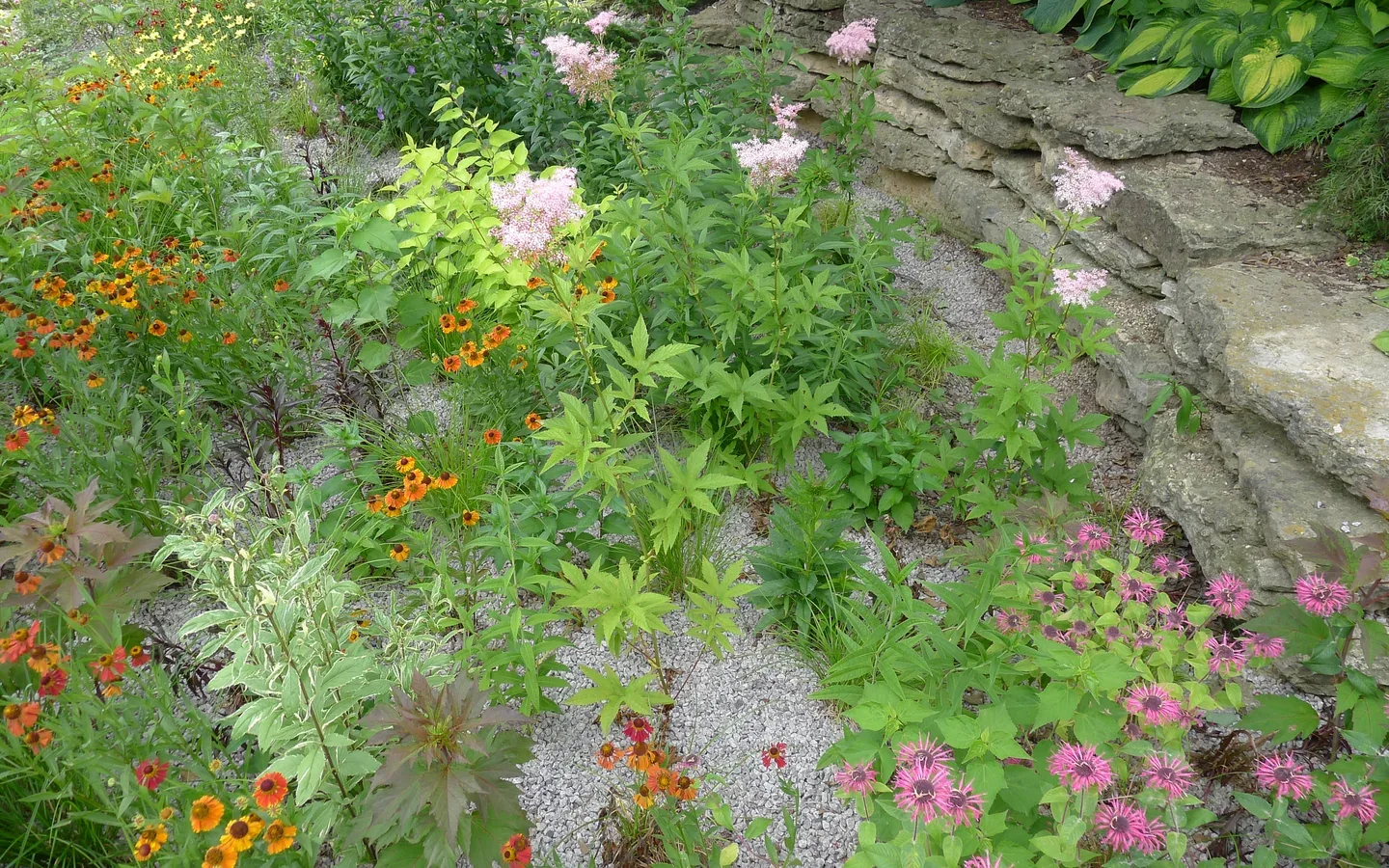
The best rain garden plants aren't necessarily pond plants. A properly functioning rain garden fills temporarily after heavy rain, then drains. For much of the year, the same ground may be no wetter than an ordinary garden bed.
This means plants in the lowest part need to tolerate brief inundation and later dryness. Plants on the upper rim may barely get wet at all. Choosing by these zones is more reliable than buying every flower labelled 'moisture loving'.
Understand the three planting zones
Picture a shallow bowl rather than a deep pool.
| Zone | What happens after rain | Planting priority |
|---|---|---|
| Base and inlet | Wettest, sometimes holding water for hours | Species tolerant of temporary wet roots |
| Sloping sides | Damp after storms but usually drains quickly | Flexible moisture-tolerant perennials and grasses |
| Upper edge | Often quite dry between storms | Ordinary border plants suited to the soil and exposure |
The planting zones shift slightly with soil type. Clay holds water longer than sandy ground; a rain garden must still drain within a reasonable time.
If water remains permanently, you may have a bog garden or drainage failure instead. Plant selection cannot fix an unsuitable drainage design.
A note on the construction
This article is about choosing plants for an existing or properly designed rain garden. Before planting a new one, test drainage, check underground utilities, plan safe overflow and avoid directing water towards foundations or neighbours.
Do not dig a depression against a house merely because it seems convenient for a downpipe. Where infiltration might affect a building, seek competent drainage advice.
The plants below work only if the site is safe and functioning as intended.
Marsh marigold for a wetter pocket
Marsh marigold (Caltha palustris) has bright yellow spring flowers and naturally favours wet ground.
It can suit a rain-garden base that remains damp for longer, especially if there is a reliably moisture-retentive pocket. It may suffer where the basin becomes bone-dry through summer.
Choose a space that suits its mature clump, and avoid burying its crown in thick mulch.
This is a native species with useful early colour. It is not a universal choice for every rain garden because its need for moisture can be greater than some designs provide.
Yellow flag iris: dramatic but large
Iris pseudacorus has tall sword-like leaves and showy yellow flowers. It tolerates very wet conditions and can work at the wettest end of a sizeable rain garden.
It is vigorous, though, and can spread strongly. In a small suburban basin it may overwhelm neighbouring plants and make maintenance difficult.
Give it room or choose a smaller alternative. Keep it away from sensitive natural waterways where unwanted plants could spread.
All parts of iris should be treated as potentially harmful if eaten; wear gloves when handling sap or dividing large clumps.
Soft rush and sedges for structure
Soft rush (Juncus effusus) brings upright stems and handles periodic wetness. It is particularly suitable where the lowest part of the basin regularly fills.
Some sedges, such as Carex pendula, tolerate moist soil, but they can self-seed and grow into substantial clumps. That makes them better in large naturalistic designs than tiny front-garden depressions.
Choose the right mature height and width instead of planting tightly for instant coverage.
The benefit of grassy or rush-like plants is that they give structure during the months when flowering perennials are not in bloom.
Siberian iris: a useful middle-zone plant
Iris sibirica has narrow foliage and elegant blue, violet or white flowers depending on variety.
It suits moisture-retentive soil and can be useful on rain-garden banks that are damp after rain but not permanently submerged.
It also tolerates ordinary garden conditions once established, making it more flexible than species that require standing water.
Allow enough light for flowering and give each clump space to develop. Divide an old crowded clump when flowering declines.
Purple loosestrife and other upright flowers
Purple loosestrife (Lythrum salicaria) is a native wetland perennial with tall purple flower spikes, visited by many insects.
It is suited to a generous wet margin where it can develop without blocking the whole basin. In a very small garden, compact cultivars or other less vigorous perennials may be preferable.
It can self-seed under suitable conditions. Manage unwanted seedlings rather than letting the planting spread into nearby sensitive habitats.
Don't rely on one towering perennial for all visual interest. Mix flowering periods and leaf textures.
Perennials for the middle slopes
The sides of a rain garden often offer the widest choice because they are wet only briefly.
Consider these where they suit your soil:
- Geranium 'Rozanne': long-flowering ground cover for a sunny or partly shaded bank.
- Daylilies (Hemerocallis): tolerant, clump-forming plants that manage a range of ordinary garden moisture conditions.
- Ajuga reptans: low evergreen or semi-evergreen cover for a shaded, damp edge.
- Campanula glomerata: upright summer flowering in a suitable well-drained position.
These species should not be placed at the deepest inlet if it stays saturated for prolonged periods. 'Moisture tolerant' doesn't mean 'aquatic'.
For cramped beds, use our plant spacing guide to plan actual mature spread instead of buying by pot size.
Shrubs for a bigger rain garden
Some shrubs tolerate temporary wetness and can make the rain garden look like part of the wider landscape.
Cornus sanguinea 'Midwinter Fire' has coloured winter stems and can work on a suitable bank. It needs room and sun for its best stem colour.
Sambucus nigra cultivars can tolerate a range of soil conditions, but mature elder plants can become large. A tiny rain garden doesn't need a full-sized elder at its centre.
Hydrangea arborescens 'Annabelle' prefers soil that retains moisture and can suit a partly shaded margin, but it still needs drainage and watering during establishment.
Keep shrub roots and eventual height clear of drainage pipes, foundations and sight lines.
Plants for the dry upper rim
The edge may never see standing water. Treat it more like a conventional border.
Choose species that cope with your normal soil and light, such as suitable hardy geraniums, nepeta or small ornamental grasses in sunny free-draining conditions.
Don't plant water-loving rushes high on a dry bank simply to make the entire feature match.
A neat low planting edge can also make a rain garden look intentional instead of like an accidental hollow in the lawn.
A simple small-garden planting plan
For a modest basin, think in groups rather than purchasing one of everything.
Place two or three clumps of compact wet-tolerant plants near the inlet. Follow with drifts of adaptable perennials on the slopes and a repeating edging plant along the upper rim.
A mixture of leaf shapes and heights looks better throughout the year than one large flowering species.
Avoid packing the inlet with so much growth that the incoming water cannot spread through the basin.
If you're measuring a planting area, our garden area calculator helps estimate the available ground before choosing quantities.
How to plant without blocking drainage
Plant at approximately the existing soil level and water plants in, using a suitable mulch where it won't wash into inlets or outlets.
Do not bury the entire basin under thick bark that floats during heavy storms. Gravel or stone may be useful in high-flow entry areas to reduce erosion.
Keep the designed overflow clear of plants with heavy spreading roots.
Water newly planted perennials during dry spells, even in a feature called a rain garden. Established roots, not the garden's name, determine how quickly plants can survive drought.
What if the soil is heavy clay?
Clay can be suitable for some moisture-loving plants, but slow infiltration is an engineering and soil issue.
If water stands for days, don't assume planting irises will make it disappear. A rain garden should empty between significant rain events.
If the soil is persistently saturated, review drainage, overflow and whether the feature needs professional redesign.
Our waterlogged garden guide explains how to distinguish poor drainage from ordinary winter dampness.
Maintenance through the first year
Check plants after the first few heavy downpours. A species that repeatedly sits under water too long may need moving uphill.
Remove weeds while the planted clumps fill out. Inspect for erosion at the inlet and clear leaves or debris from the overflow.
During summer drought, water new plants until they are established. Avoid applying fertiliser into the basin where it could wash out with runoff.
Keep records of which zones stay damp longest; those observations are more useful than a generic 'rain garden plants' label.
Common planting mistakes
Treating the entire basin as a pond: choosing only aquatic plants leads to drought losses when water drains.
Overplanting the inlet: obstructs the flow the feature was designed to handle.
Using vigorous sedges in a tiny bed: creates future maintenance and spreading problems.
Ignoring the dry upper edge: can leave plants stressed through summer.
Covering the overflow with shrubs: creates a safety and flooding risk.
Buying only flowers that bloom together: leaves the feature visually bare for much of the year.
Quick answers
Can lavender grow in a rain garden? Only on a genuinely dry, free-draining upper edge, not where water routinely pools.
Do rain gardens need watering? Newly planted material does during dry spells; established planting should suit the site's natural moisture pattern.
Which plant is best for the centre? It depends on the wet period and basin size. Marsh marigold or soft rush can suit some wetter sites.
Should I use only native plants? Native planting can benefit biodiversity, but correct site conditions and responsible species selection remain essential.
Choose plants according to where the water actually goes. A successful rain garden has a wet-tolerant centre, adaptable slopes and a dry-suited edge—working together rather than fighting the drainage.