
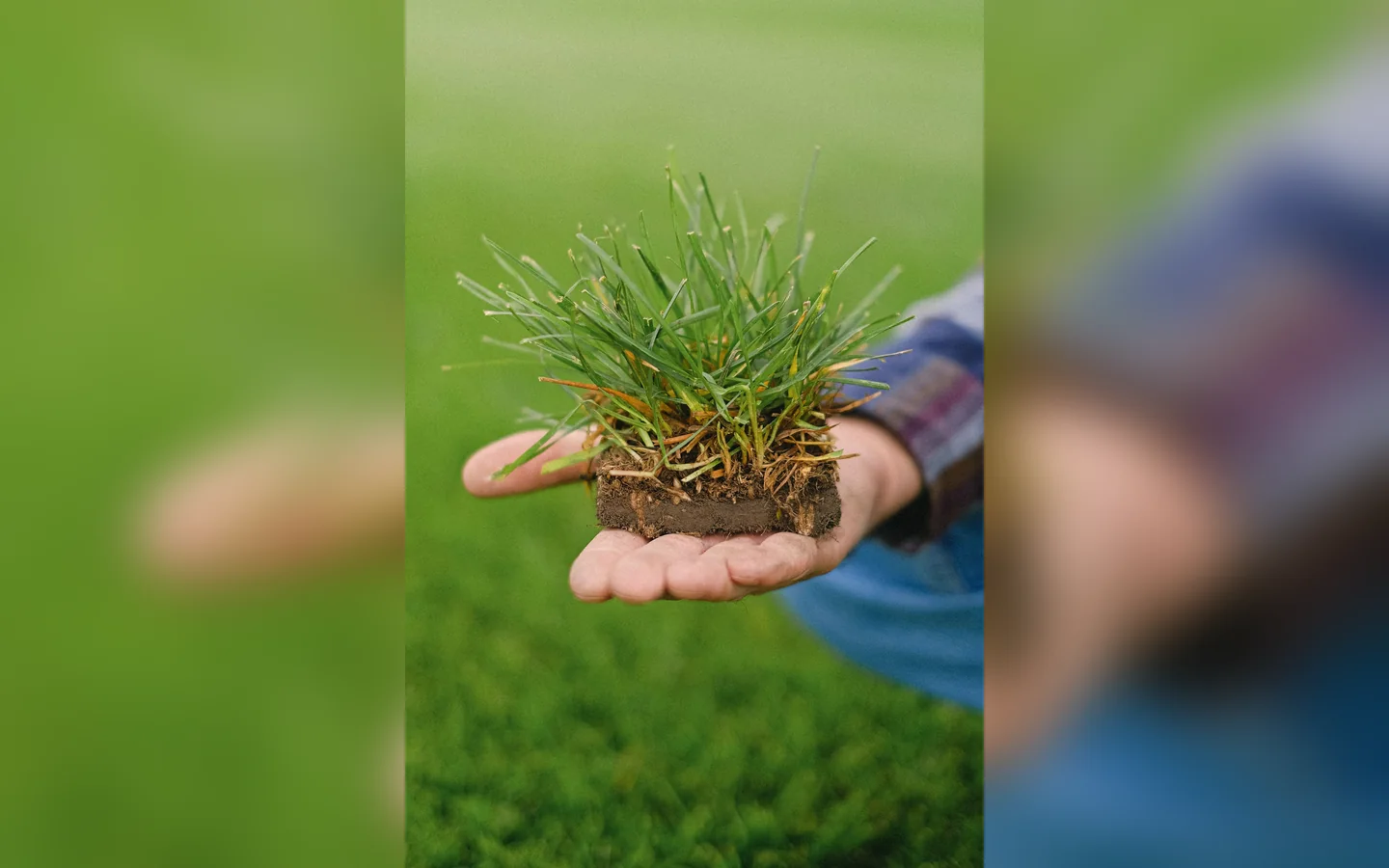
Healthy lawn grass depends on the soil beneath it. A surface can look green in spring yet fail every summer because roots only reach a few centimetres, the subsoil is full of rubble or heavy traffic has squeezed the ground tight.
Improving lawn soil doesn't automatically mean digging up the grass. The right work depends on whether the problem is compaction, insufficient depth, drainage, pH or poor growing conditions.
What makes good lawn soil?
A useful rooting zone has a stable crumb structure, enough pore space for air and water, suitable nutrients and enough depth for roots to explore.
Soil does not need to be especially rich. A low-maintenance lawn may grow well with modest fertility, while heavy feeding can create soft leaf growth that needs more mowing.
The soil should hold moisture without remaining waterlogged. Fine grass roots need oxygen as well as water.
Diagnose the actual limitation
| Symptom | What to investigate |
|---|---|
| Hard worn strips | Compaction from traffic |
| Grass browns quickly in heat | Shallow soil, drought, buried rubble or roots |
| Puddles remain after rain | Surface levels, compaction, clay subsoil or high groundwater |
| Weak growth only under trees | Light and competition for moisture |
| Pale lawn everywhere | Soil fertility, pH, roots and recent care |
| Repeated bare patch in one place | Soil contamination, drainage, shade or use |
| Patch feels springy | Excess thatch rather than poor mineral soil alone |
A lawn under deep shade cannot be made dense by adding more compost and fertiliser.
A simple soil investigation
Select a small area where grass performs badly and one nearby area where it grows well.
When soil is workable, lift a narrow sample to inspect the topsoil depth, root distribution, compact layers and any buried building debris. Replace the turf promptly.
Compare how damp the samples are after rain. If one section has only a few centimetres of topsoil over rubble, that may explain why it dries rapidly.
Avoid digging near utilities, irrigation pipes or major tree roots.
Is a soil test worth it?
If a lawn remains weak after sensible maintenance, a laboratory or reliable garden soil test may help identify pH or nutrient imbalance.
Don't automatically add lime because moss is present. Moss doesn't prove that soil is acidic.
Likewise, nitrogen feed isn't a repair for saturated soil or roots that cannot reach deeper layers.
Use test results to guide any amendments rather than following a generic “one handful per square metre” recipe.
Improve compacted soil with suitable aeration
When compaction is confirmed, hollow-tine aeration removes narrow cores and may improve access for air and water.
Do it when turf can recover, commonly in early autumn or spring, and when soil is moist but not saturated.
Pushing solid tines into very compacted clay can compress soil around the holes. A proper hollow-tine machine is often preferable for severe compaction.
Avoid treating a healthy lawn annually without evidence that this work is needed.
Should you topdress the lawn?
A thin layer of compatible lawn topdressing can improve minor surface irregularities and gradually help a poor surface rooting zone.
The mix must suit the soil and your goals. Pure builders' sand poured onto clay can create an unsuitable layer; dumping a thick blanket of topsoil over living grass can smother it.
Brush thin dressing down between blades and into aeration holes where appropriate, keeping green grass exposed.
Our lawn topdressing depth guide explains the practical depth limits, and our lawn topdressing calculator helps estimate material.
Organic matter: where it helps
Organic matter can improve soil structure, moisture retention and biological activity. But a lawn differs from a vegetable bed—you cannot routinely dig 10cm of compost into it while preserving turf.
Appropriate surface dressing and normal decomposition of fine grass clippings may gradually contribute organic material.
If you are renovating a completely failed lawn, there is more opportunity to prepare the soil thoroughly and incorporate suitable soil-improving materials before reseeding or returfing.
A thin lawn isn't necessarily a reason to excavate the whole garden.
Can you improve soil without killing the grass?
Yes, for many ordinary problems. Correct mowing height, reduced traffic, targeted hollow-tining and appropriate light topdressing can help.
However, if a lawn is laid over a very shallow layer of soil above concrete, hard rubble or unsuitable fill, fundamental renovation may be needed.
Assess the scale before spending money on repeated superficial treatments.
Soil beneath mature trees
Tree roots compete with grass for water and nutrients. They also make digging risky; cutting roots to create more lawn soil can harm valuable trees.
Where shade and roots severely limit grass, consider a shaded ground-cover planting or a mulched area instead.
Raising the soil level over established tree roots can also damage them. Don't bury root flares to force a lawn.
How to help lawn soil retain moisture
Allow appropriate grass height during dry weather to shade the soil surface and reduce stress.
Where soil is extremely sandy, modest organic matter inputs during planned renovation may improve water-holding capacity.
For established turf, suitable management helps roots develop rather than relying on daily shallow watering.
Newly seeded lawns need more regular surface moisture until roots establish; mature grass is different.
Drainage problems require separate diagnosis
Soil improvement helps only where the site actually can drain.
A high water table, blocked drain or incorrectly directed patio runoff needs a different fix from minor compaction.
Don't add fertiliser to grass whose roots are losing oxygen in saturated soil.
For recurring winter damage, see muddy lawn in winter.
Choosing a seed mix for the soil
Once roots have reasonable conditions, choose grasses suited to the level of shade, wear and available moisture.
A hard-wearing ryegrass mix may suit a sunny family lawn. A fine shaded lawn requires a different approach, and permanent deep shade may still be unsuitable.
Our grass seed calculator helps measure new seed for renovation patches.
A realistic first-year plan
Spring: diagnose weak sections, check mower height and investigate obvious compaction.
Summer: observe which areas dry first and avoid unnecessary traffic during stress.
Early autumn: carry out justified aeration, light dressing and overseeding while turf can recover.
Winter: avoid machinery and foot traffic on saturated ground; plan repairs for workable conditions.
Improving roots is a longer-term process. The best sign of success is healthier growth and deeper roots next season, not just a greener surface tomorrow.
Mistakes to avoid
- Adding lime or feed without diagnosing the problem.
- Putting builders' sand on heavy clay as a universal fix.
- Burying live grass under a thick layer of compost.
- Digging through large tree roots.
- Aerating frozen or waterlogged ground.
- Repeatedly seeding without fixing a buried hard layer.
- Assuming every poor lawn needs soil replacement.
Should I add compost to an established lawn?
Only in a suitable compatible thin dressing or during planned renovation. Thick loose compost can smother living grass.
Does aeration improve soil quality?
It can improve the physical root environment where compaction exists, but won't automatically correct pH, nutrients or poor drainage design.
How can I tell if my lawn has enough topsoil?
Inspect a small sample for root depth, stones and restrictive layers, comparing a failing area with a healthier section.