
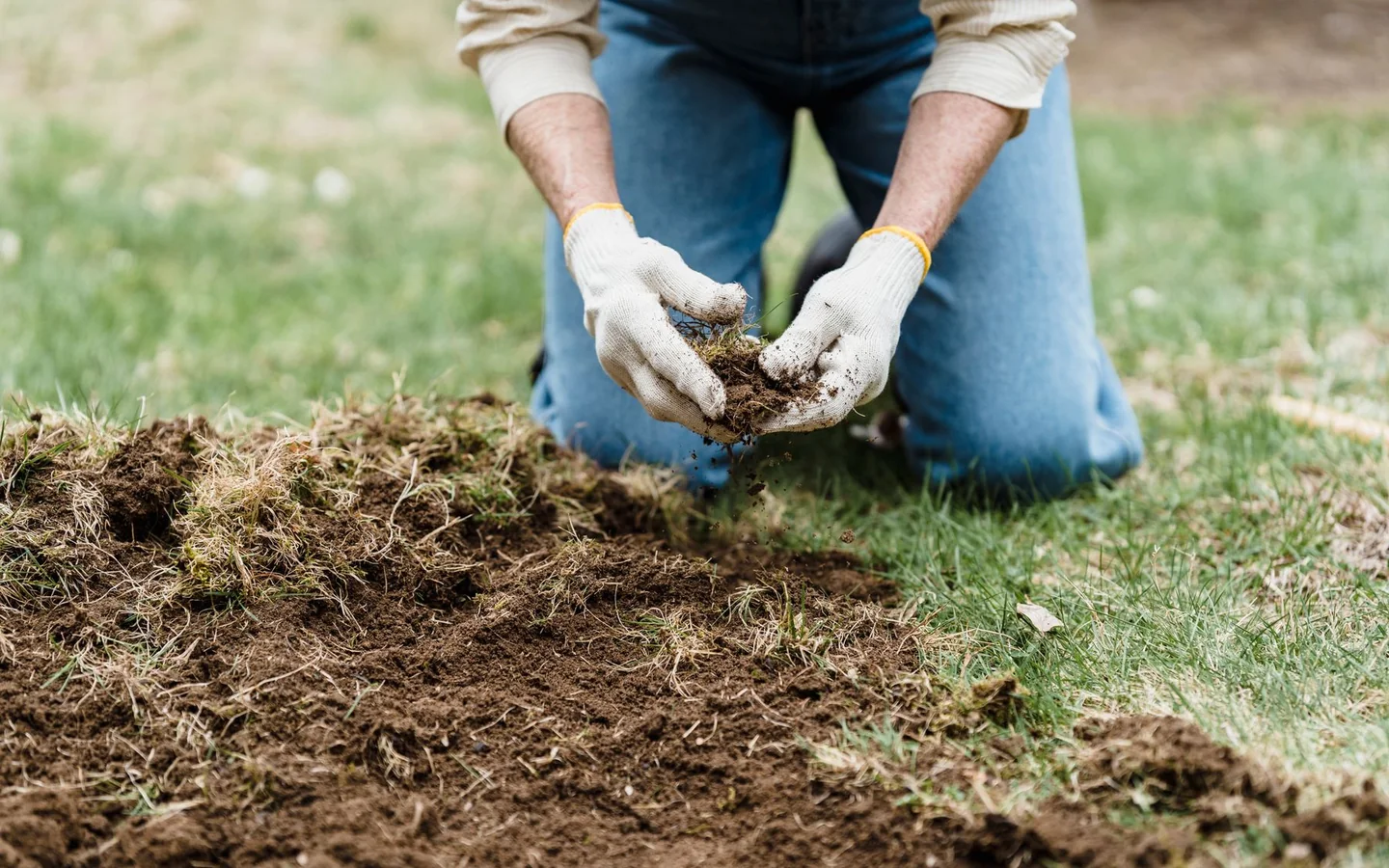
A slightly uneven lawn can cause scalping when the mower runs over high spots and leave puddles in dips. But it doesn't always need digging up. Small imperfections can often be corrected with careful topdressing; deeper hollows call for lifting the turf and adjusting the soil underneath.
Don't bury living grass under a thick layer of soil in one pass. That creates new dead patches rather than a smoother lawn.
Decide how uneven the ground is
Check the lawn after mowing and use a straight board or string line to see where depressions actually lie.
| Problem | Suitable approach |
|---|---|
| Tiny shallow dips | Thin compatible lawn topdressing |
| Several dips less than roughly 1cm | Staged light dressing, repeated if needed |
| Single deeper hollow | Lift turf, add soil beneath, replace |
| Raised local bump | Lift turf, remove excess soil, relay |
| Whole lawn slopes badly towards a house | Professional drainage and grading assessment |
| Uneven lawn caused by moles or other animals | Address the cause before levelling |
A lawn does not have to be perfectly flat. A sensible fall away from structures can be important for drainage.
When to level a lawn in the UK
Choose a period when grass is growing and can recover—often spring or early autumn.
Avoid working soil when frozen, severely dry or saturated. Wet clay can smear and compact under even light repeated traffic.
For a lawn already struggling with winter mud, correct drainage and wear before adding topsoil. Our muddy winter lawn guide covers that first step.
Materials you'll need
For light dressing, choose a suitable sandy lawn topdressing mix appropriate to the existing soil. That is different from dumping pure building sand onto a clay lawn.
For more substantial hollows, use compatible screened topsoil and, if needed, a suitable dressing over the final turf.
Tools include a stiff garden broom, shovel, rake, flat-bladed spade, straight board and watering can or hose.
The lawn topdressing calculator helps estimate volumes once you've measured the area and chosen a realistic depth.
Method one: light topdressing
- Mow the lawn to an appropriate height without scalping.
- Remove large debris and any thick moss or thatch where necessary.
- Spread a thin layer of compatible dressing, concentrating on small low areas.
- Use a stiff broom or levelling lute to brush material down among the grass blades.
- Make sure the majority of grass tips remain visible.
- Water lightly if needed and allow the turf to grow through.
- Reassess after recovery before repeating another light layer.
Don't keep spreading soil until a depression is filled in one afternoon if that would bury the grass.
How thick should the dressing be?
For many existing lawns, aim for just a few millimetres at a time, rather than applying centimetres of material over living blades.
The safe depth depends on grass height, density, dressing texture and whether the area already has bare soil.
If a hollow is several centimetres deep, lifting and relaying the turf usually offers a more reliable result.
Our lawn topdressing guide explains depth and quantities in more detail.
Method two: lift turf to correct a deeper hollow
A practical technique for one contained dip is an H-shaped incision in the turf.
Cut with a sharp flat-bladed spade and carefully peel back the two flaps while keeping roots and soil together as much as possible.
Add compatible soil beneath the low section, lightly firm and check the level with a board. Relay the turf flaps in their original positions, press the edges into contact and brush dressing into any gaps.
Water appropriately and keep traffic off while the roots recover.
How to lower a raised bump
The process is similar, except you remove some soil beneath the lifted turf.
Don't simply scalp the bump repeatedly with a mower. It will weaken grass and make the mound look brown.
Work gradually, keep soil levels sensible around trees and edging and avoid cutting through substantial roots.
If the bump is caused by a tree root, don't cut or bury the root to force a flat surface. Adjust the lawn design or consult an arborist.
Calculate material before buying
Work out the area of each section in square metres and the average planned depth.
For example, covering 10m² to a depth of 5mm uses roughly 0.05m³, or 50 litres, before losses and settling.
Large bags sold by weight may not correspond exactly to the calculated volume because moisture and bulk density vary.
Our calculator handles the arithmetic; add a modest allowance rather than ordering enough to bury the entire lawn.
What if the unevenness is caused by poor drainage?
Low areas can collect water because the surface directs it there. But if soil beneath is compacted or impermeable, raising the surface alone may just shift the puddle.
Check where runoff originates and whether a safe lawful outlet exists before changing large ground levels.
Avoid sending surface water towards the house or neighbours. Where a retaining wall or foundation is affected, seek qualified drainage advice.
How to check the finished level
Lay a long straight board over several directions, looking for obvious dips without trying to make the entire surface laser-flat.
Walk across the area carefully and check whether the turf feels firm rather than springy over loose uncompacted fill.
After the next heavy rainfall, look for pooling that reveals remaining low points.
Don't keep driving a roller over wet clay in pursuit of a perfectly smooth finish; heavy rolling can compact the rooting soil.
Lawn edges and mowing
Leave the turf flush with adjacent patios and paths without covering drain openings or raising soil above appropriate boundary levels.
A sharp mower blade and sensible mowing height reduce the appearance of small imperfections while newly adjusted areas establish.
If unevenness repeatedly causes mower scalping, our lawn care in November guide offers general seasonal care, although levelling itself is better done when grass can recover.
When full renovation is justified
Where substantial construction rubble, large ruts or an unsafe slope affect most of the lawn, spot dressing won't solve the problem.
A more substantial renovation may require stripping turf, grading soil, providing appropriate drainage and seeding or laying turf afterward.
Get professional help if the problem involves subsidence, retaining walls, property foundations or large changes to drainage.
Common levelling mistakes
- Adding centimetres of soil over living grass in one go.
- Trying to fix a deep hole with repeated piles of dressing.
- Rolling saturated clay heavily.
- Raising ground against walls or damp-proof courses.
- Cutting major tree roots to flatten the lawn.
- Redirecting water into neighbouring property.
- Buying sand without checking compatibility with the soil.
Can I level a lawn without removing the grass?
For shallow unevenness, yes. Thin dressing can work; deeper hollows are usually better corrected under lifted turf.
Is topsoil or sand better?
Use suitable lawn dressing for light work and compatible topsoil for deeper sub-turf adjustments. Pure sand is not a universal solution.
Should I roll a bumpy lawn?
Heavy rolling rarely corrects underlying dips and can compact wet soil. Targeted levelling is more effective.